Reset your skin.
Men's Exfoliation Guide: How to Exfoliate Properly (2026)
14 min read
2026-04-05
In This Article
Why Your Skin Is Aging Faster Than It Should
Physical vs. Chemical: What's the Actual Difference?
How Often Should Men Exfoliate?
The Process: 5 Steps, Under 4 Minutes
What Exfoliation Does for Razor Bumps
Exfoliation by Skin Type: Frequency and Method
7 Signs You're Overdoing It
How to Pick the Right Mens Exfoliating Scrub
Frequently Asked Questions
The Manifesto
Men's Exfoliation Guide: The Reset Your Skin Needs (2026)
Every week your skin is carrying what you didn't clear. That weight shows.
Dead cells stacking on the surface. Sebum trapped in follicles. That grey, tired look you keep blaming on sleep. None of it is inevitable. It is the result of a step most men skip entirely.
Using a mens exfoliating scrub twice a week changes the whole picture. Not because it is "extra." Because skin that gets cleared performs differently. Absorbs better. Shaves cleaner. Looks sharper. The global exfoliators market hit USD 6.85 billion in 2023 and is tracking to USD 11.50 billion by 2030, with men's exfoliator demand growing at 10.0% CAGR, the fastest segment (Grand View Research, 2024). Men are waking up to this.
This guide is for men who want results, not a lecture.
The Bottom Line
Your skin accumulates dead cells for 10+ extra days by your 30s and 40s compared to your 20s -- exfoliation closes that gap (PubMed / Skin Research and Technology, 2023).
Exfoliate the face 2-3x per week (oily/normal) or 1x per week (dry/sensitive). Never on shave day.
Up to 83% of Black men deal with razor bumps -- consistent exfoliation is the primary fix without a prescription (NIH / PMC).
Over-exfoliation is real: 68% of dermatologists treated barrier damage in 2024 linked to over-exfoliation (International Dermal Institute, 2024).
EXFOLIARE is the reset tool. Twice a week, clear the surface, start again.
Why Your Skin Is Aging Faster Than It Should
Men produce roughly 25% more sebum than women. Thicker skin. Larger pores. That combination traps debris deeper in the follicle than most men realise.
Here is what nobody tells you. Cell turnover slows with age -- dramatically. In your 20s, skin renews roughly every 20 days. By your 30s and 40s, that cycle stretches past 30 days (PubMed / Skin Research and Technology, 2023). You are wearing ten extra days of dead skin. That is the grey. That is the dullness. That is the texture that moisturiser sits on top of instead of sinking into.
Shaving does not solve it.
A razor clears the surface but it does not touch the pore. Dead cells wrap around curling hairs and you get the bump. They mix with sebum and you get the jaw blackhead. A proper mens exfoliating scrub targets both problems at the root.
The fix is not complicated. It is just uncommonly committed.
Citation Capsule Skin cell turnover slows by roughly 10 days between a man's 20s and his 40s and 50s. That delay produces visible dullness, uneven texture, and reduced product absorption. Consistent exfoliation compensates for this slowdown by manually clearing accumulated dead cells (PubMed / Skin Research and Technology, 2023).
Physical vs. Chemical: What's the Actual Difference?
Stop thinking of these as competitors. They do different things.
Physical exfoliants work with friction. You scrub, dead cells lift. Immediate smoothness. You feel the result in the moment. Chemical exfoliants dissolve the bonds between dead cells using acids or enzymes. No scrubbing required. They work while you sleep.
Most men benefit from both.
A mens exfoliating scrub 1-2x per week. A BHA or AHA cleanser on alternating days. That combination handles oil, ingrowns, and surface texture without burning the barrier down.
Factor | Physical Exfoliants | Chemical Exfoliants |
|---|---|---|
How it works | Friction lifts dead cells | Acids or enzymes dissolve cell bonds |
Pros | Immediate smoothness, preps beard area | Even coverage, reaches into pores |
Cons | Abrasion risk if grit is too sharp | Sun sensitivity, slower visible results |
Best for | Oily, thick skin, pre-shave prep | Sensitive, aging, uneven tone |
Examples | Sugar, bamboo, jojoba beads | Glycolic, salicylic, lactic, papain |
Physical Scrubs: What to Look For
Grit quality determines everything. Round particles -- sugar, jojoba beads, bamboo powder -- lift without tearing. Walnut shell is jagged. It leaves micro-tears that invite bacteria. Avoid it.
A good face scrub for men should dissolve slightly as you massage. You should be able to press into your jaw with no pain whatsoever.
Physical scrubs earn their place most on the body and beard area. They lift embedded hairs. They prep the follicle so a blade makes clean contact instead of catching and dragging.
Chemical Exfoliants: The Right Acid for the Right Problem
They sound aggressive. They are not.
Salicylic acid (BHA) is oil-soluble. It goes into the pore, which is why it dominates acne formulas. Glycolic acid (AHA) works the surface for tone and lines. Lactic acid exfoliates while it hydrates -- it is the gentlest entry point for men with dry or reactive skin.
Acid / Enzyme | Depth | Best Skin Type | Primary Use |
|---|---|---|---|
Glycolic (AHA) | Deepest surface | Normal, aging, dull | Tone, texture, fine lines |
Lactic (AHA) | Moderate | Dry, sensitive | Hydrating exfoliation |
Salicylic (BHA) | Into the pore | Oily, acne-prone | Blackheads, breakouts |
Mandelic (AHA) | Shallow | Sensitive, darker skin | Gentle tone correction |
PHAs | Very shallow | Reactive, rosacea-prone | Barrier-safe starting point |
Enzymes (papain, bromelain) | Surface only | All types | Weekly polish |
How Often Should Men Exfoliate?
Frequency is where men either get results or get damage. The American Academy of Dermatology is clear: match frequency to skin type and tolerance, increase gradually, never force it (AAD).
More is not more. More is damage.
Face, oily or normal: 2-3x per week
Face, dry or sensitive: 1x per week
Body (back, chest, upper arms): 1-2x per week
Beard area and neck: 2x per week, the night before a shave
Never exfoliate immediately before shaving. The barrier is temporarily lowered after a scrub. Running a blade over it invites irritation that lingers for days. Exfoliate the night before and let the skin recover.
We hear this from men all the time at Gods and Mony: they started a routine, went hard three days in a row, and ended up with worse skin than before. The issue isn't exfoliation. It's impatience. Two days on, five days off. That is how you build tolerance, not break the barrier.
Citation Capsule In a 2024 survey, 68% of dermatologists reported treating patients for barrier damage, contact dermatitis, or purging directly linked to over-exfoliation and viral skincare trends (International Dermal Institute, 2024). The damage is not from exfoliation. It is from frequency without restraint.
The Process: 5 Steps, Under 4 Minutes
Men overthink this.
1. Warm water first. Thirty seconds under warm (not hot) water or at the end of a shower. Warmth loosens sebum plugs and softens the surface. You need less pressure when skin is prepped.
2. Apply your scrub. A nickel-sized amount of your mens exfoliating scrub on damp skin. Small upward circles for 20-30 seconds. No dragging. No hard pressure. Forehead, nose, cheeks, jaw, neck. Skip the eye socket entirely.
3. Rinse clean. Lukewarm water until the skin feels clean, not squeaky. Squeaky means you stripped the barrier. That is not the goal.
4. Treat. Pat dry. Apply your serum. Freshly exfoliated skin absorbs actives 20-40% better than unexfoliated skin. The timing is not incidental -- it is the whole point (Mintel, 2024).
5. Seal it. Moisturise. Every time. Even oily skin. The lipid layer needs to be repaired after any exfoliation. Skipping it invites rebound oil production and a compromised barrier.
What Exfoliation Does for Razor Bumps
Razor bumps are not a cosmetic issue. They are inflammation.
Up to 83% of Black men experience pseudofolliculitis barbae (PFB). The mechanism is straightforward: curly hair re-enters the skin after shaving or never fully exits the follicle. The skin reads it as a foreign body and mounts an immune response. That is the bump. That is the hyperpigmentation that follows (NIH / PMC).
Consistent exfoliation resolves 60-80% of mild to moderate PFB without a prescription. It keeps the follicle clear. It keeps the hair on the correct growth path. It reduces the inflammation that builds over weeks of skipping the step.
The protocol:
Night before shaving: exfoliate with a salicylic acid cleanser or fine physical scrub. Lifts hairs out of the follicle.
Shave day: sharp single or two-blade razor. Shave with the grain. Multi-blade razors cut below skin level and worsen PFB.
Post-shave: 2% BHA toner on active bump zones.
Between shaves: exfoliate the beard line 2x per week, no exceptions.
Men who maintain a twice-weekly exfoliation protocol along the beard line report fewer active bumps and significantly less post-shave redness within 3-4 weeks. That's what we hear consistently from Gods and Mony customers who start with EXFOLIARE. The results are not dramatic. They're incremental, and they compound.
Citation Capsule Pseudofolliculitis barbae (razor bumps) affects up to 83% of Black men. Curly hair increases PFB risk by a factor of 50. Consistent exfoliation with salicylic acid and a fine physical scrub is the primary non-prescription intervention, resolving 60-80% of mild to moderate cases (NIH / PMC).

Exfoliation by Skin Type: Frequency and Method
Your skin type sets the parameters. There is no universal answer -- but there is a right answer for your face.
Skin Type | Frequency | Best Method | Avoid |
|---|---|---|---|
Oily / Acne-prone | 2-3x per week | Salicylic BHA + sugar scrub | Heavy oil-based scrub formulas |
Dry | 1x per week | Lactic acid or enzyme mask | Strong physical scrubs, high-% glycolic |
Sensitive | 1x per week or less | PHA, mandelic, papain enzyme | Walnut shell, AHAs above 5% |
Combination | 2x per week | Gentle AHA blend or fine sugar scrub | Over-scrubbing the T-zone only |
Normal | 2x per week | Glycolic or sugar-based scrub | Skipping SPF after morning exfoliation |
Oily or Acne-Prone Skin
Salicylic acid goes into the pore. It cuts through sebum at the follicle wall. Pair it with a physical scrub 1-2x weekly to clear the surface debris. Keep oil-heavy scrub bases away from active acne zones.
Dry Skin
You don't need aggression. You need precision. Lactic acid exfoliates while it hydrates. Enzyme masks polish without stripping. Once a week is sufficient. Twice is too much for most dry-skin men.
Sensitive Skin
Start with PHAs. Largest molecules, shallowest penetration, barrier-safe. Two weeks of PHAs with no reaction? Move to mandelic acid. If any scrub feels gritty between your fingers, it is too aggressive for your face.
Combination Skin
Treat your T-zone and cheeks as two different climates. A balanced AHA/BHA formula covers both. If you prefer a physical scrub, fine sugar or bamboo with lighter pressure on the cheeks.
7 Signs You're Overdoing It
More is not dedication. More is damage.
Over-exfoliation is more common than under-exfoliation among men who start routines hard and fast. The barrier breaks down faster than most expect.
Watch for these signals:
Tight, shiny skin that feels stretched after cleansing
More oil than usual -- paradoxical, because barrier damage triggers compensatory sebum
Redness that lingers more than one hour post-exfoliation
Stinging when you apply moisturiser -- that is broken barrier, not product sensitivity
Small rough bumps under the skin that are not acne
Breakouts in new locations you do not normally break out
Peeling that moisturiser does not fix
Stop everything for 10-14 days. Gentle cream cleanser only. Ceramide or panthenol moisturiser. SPF 30+ every morning. Reintroduce exfoliation once per week with a PHA, then build slowly over 3-4 weeks.
The skin will tell you when it is ready.
How to Pick the Right Mens Exfoliating Scrub
Three things. That is all you need to evaluate.
Ingredient integrity. Read the first five ingredients. Denatured alcohol, synthetic fragrance, polyethylene microbeads -- any of these, put it back. A clean formula uses plant-derived exfoliants: sugar, bamboo, fruit enzymes. Or well-formulated acids at disclosed concentrations.
Grit calibration. Test it between your fingers before it touches your face. Round and slightly dissolving means safe. Sharp and gritty means micro-tears. That distinction matters every time you use it.
Base formula. The scrub is only as effective as what it is suspended in. A moisturising base -- glycerin, aloe, plant oils -- protects the barrier during exfoliation. A drying base compounds the damage.
Most men choose a scrub based on how it smells or how the packaging looks. That is backwards. The grit particle shape determines whether you are clearing skin or tearing it. The base formula determines whether the routine builds the barrier or drains it. Smell is last on the list.
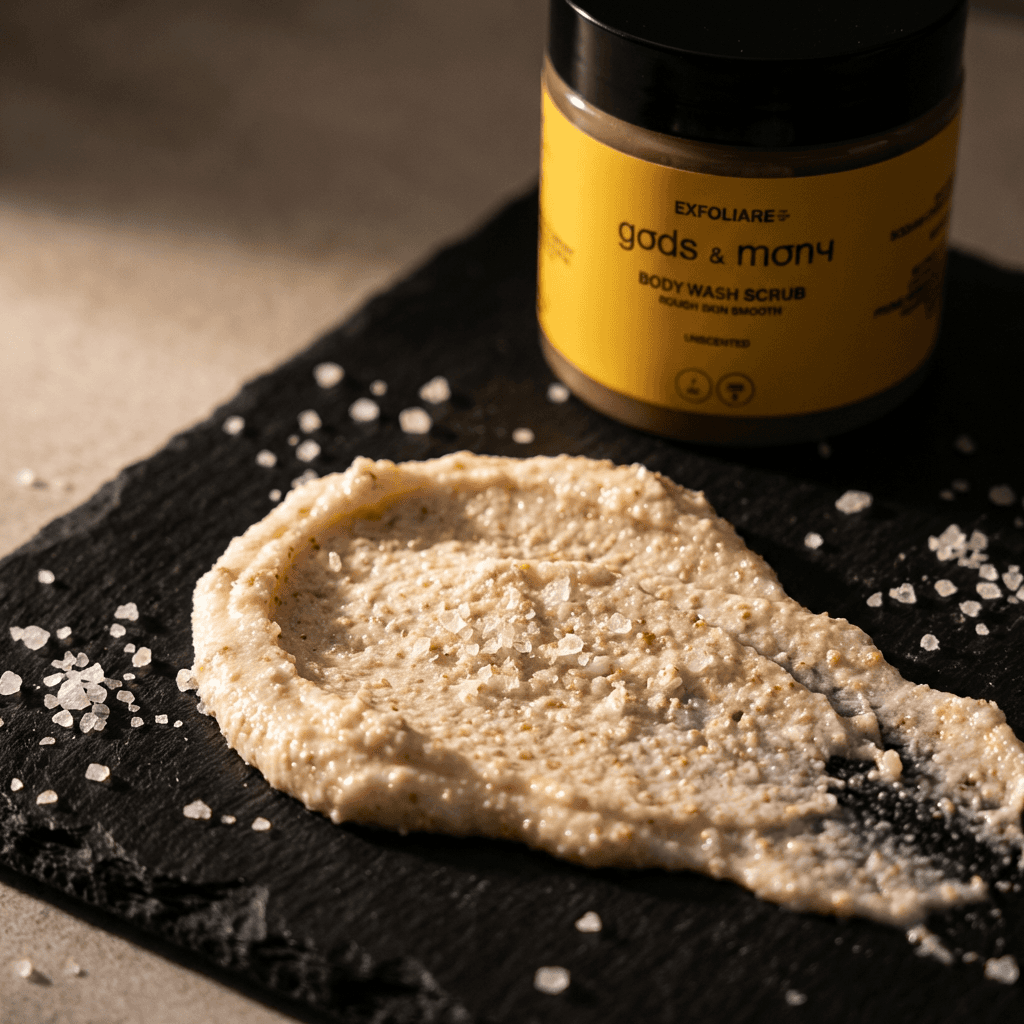
EXFOLIARE Exfoliant is a clean, USA-made mens exfoliating scrub with a plant-based grit profile and a barrier-safe base. Twice a week, you clear the surface and start again. That is the reset.
Want the full system -- cleanser, exfoliant, moisture -- see the skincare collection. Not sure where to start, take the skin quiz and get matched in under two minutes.
Frequently Asked Questions
How often should a man use a mens exfoliating scrub on his face? Two to three times per week for oily or normal skin. Once per week for dry or sensitive skin. The AAD advises starting slow and building tolerance before increasing frequency. Never exfoliate and shave on the same day -- the barrier cannot handle both (AAD).
Can I use a mens exfoliating scrub every day? Rarely necessary and frequently damaging. In 2024, 68% of dermatologists treated barrier damage linked to over-exfoliation (International Dermal Institute, 2024). If you want daily use, choose a very gentle PHA cleanser. Not a scrub, not a high-% acid.
Is physical or chemical exfoliation better for men? Both have a role. Physical scrubs deliver immediate smoothness and help beard-area ingrowns. Chemical exfoliants distribute more evenly and work deeper into the pore -- better for sensitive or aging skin. Most men benefit from running both: a scrub 1-2x weekly, a BHA or AHA cleanser on alternating days.
Should I exfoliate before or after shaving? The night before, not immediately before. Freshly exfoliated skin has a temporarily lowered barrier. Shaving on it raises irritation risk significantly. Exfoliate the night before: it lifts hairs, softens the follicle, and makes the shave cleaner and closer.
Can exfoliation clear razor bumps? Yes. Razor bumps (pseudofolliculitis barbae) occur when curled hairs re-enter the skin after shaving. Up to 83% of Black men deal with PFB. Consistent salicylic acid exfoliation and a fine physical scrub resolves 60-80% of mild to moderate cases by keeping follicles clear (NIH / PMC). It is not instant. It takes 3-4 weeks of consistency.
The Manifesto
Exfoliation is not a trend. It is not maintenance. It is a decision about what you bring into the next version of yourself.
Dead skin is literal weight. Old cells, trapped sebum, the residue of weeks you did not clear. Every man who has started a consistent exfoliation routine says the same thing: his products started working better, his shaves got cleaner, and his face stopped looking like it was holding something.
That is what the reset does.
Men who exfoliate aren't doing extra. They're doing what the man they're becoming already does. They've decided that what's on the surface matters, because they know it reflects something underneath.
EXFOLIARE is what the reset looks like. Twice a week, clear the surface, start again.
Build the full system at the Gods and Mony skincare collection. Or take the skin quiz to know exactly where to start.
Related Reading
The Complete Men's Skincare Routine (2026)
Best Moisturizer for Men: How to Choose One That Works
Men's Body Wash Guide: Soap vs Wash vs Scrub
Sources
PubMed / Skin Research and Technology (2023): Age-dependent changes in epidermal architecture. https://onlinelibrary.wiley.com/doi/10.1111/srt.13343
NIH / PMC: Pseudofolliculitis barbae: current treatment options. https://pmc.ncbi.nlm.nih.gov/articles/PMC6585396/
Grand View Research (2024): Global Exfoliators Market Report. https://www.grandviewresearch.com/industry-analysis/exfoliators-market-report
American Academy of Dermatology: How to safely exfoliate at home. https://www.aad.org/public/everyday-care/skin-care-secrets/routine/safely-exfoliate-at-home
International Dermal Institute (2024 survey via dermatology press). https://www.dermalogica.com/blogs/skin-health/the-international-dermal-institute
Mintel (2024): Men's facial skincare adoption up 68% since 2022. https://www.mintel.com/press-centre/more-than-half-of-us-men-now-use-facial-skincare-a-68-increase-from-2022/

Gods and Mony Editorial
Editorial Team
Next posts