Your routine. Your standard.
The Men's Skincare Routine Is a Discipline Thing. Your Skin Just Shows It.
19 min read
2026-08-06

In This Article
Why Your Skin Is a Reflection of Your Habits
What Makes Men's Skin Different (and Why It Matters)
The Four Moves of a Man Who Has Decided
Morning vs. Night: The Same Discipline, Different Direction
The First 90 Days: How a Skincare Routine for Men Actually Sticks
Does Your Skin Type Change the Moves? Yes. Does It Change the Framework? No.
The Mistakes Men Make (and What They Actually Cost)
How Long Until You See the Results?
Frequently Asked Questions
The Manifesto
Related Reading
The Men's Skincare Routine Is a Discipline Thing. Your Skin Just Shows It.
A routine isn't a skincare thing. It's a discipline thing. The skin is just where it shows.
Most men know they should have a mens skincare routine. Half of them have started one. US men's grooming sales topped $7.1 billion in 2025, up 6.9% year over year (NielsenIQ, 2025), and 68% of Gen Z men aged 18-27 now use facial skincare, up from 42% just two years earlier (Mintel, 2024). But knowing and deciding are two different things. This guide is for the man who has decided. We're not going through "steps." We're going through moves. Four of them. Backed by the science, stripped of the noise, built around the four Gods and Mony products that exist for exactly this purpose.
Key Takeaways
A mens skincare routine is not a beauty protocol. It's identity architecture.
UV exposure drives roughly 90% of visible skin aging (Skin Cancer Foundation, 2024). SPF is not optional.
Skin cell turnover slows from 28 days in your 20s to 60 days in your 50s (PubMed). Consistency compounds.
Four moves cover everything: cleanse, exfoliate, hydrate, protect. That's it.
A health-behaviour habit takes a median of 59-66 days to set, not 21 (Singh et al., Healthcare, 2024). Plan for the quarter, not the fortnight.
73% of Americans use something to prevent premature aging, but only 56% use sunscreen regularly (American Academy of Dermatology, 2025). The gap is wide. The fix is fast.
Why Your Skin Is a Reflection of Your Habits
The man with a morning routine isn't chasing results. He's already decided who he is.
Skin is the most visible organ you have. It accumulates everything: the stress, the sleep debt, the skipped mornings, the consistency. More than half of US men now use facial skincare, and among Gen Z men that figure has reached 68%, up from 42% two years prior (Mintel, 2024). The cultural shift already happened. The question now is whether you're building something intentional or just reacting.
UV exposure accounts for roughly 90% of visible skin aging (Skin Cancer Foundation, 2024). That's not a skincare fact. That's a maintenance fact. Like oil changes.
The man who starts at 25 looks different at 40 than the man who starts at 39. The biology is clear on this. What separates the two isn't product knowledge. It's the ability to keep doing an unglamorous thing on the days it doesn't feel like it matters.
Founder's note. Gods and Mony was built on one observation: men with the sharpest skin don't have complicated routines. They have consistent ones.
What Makes Men's Skin Different (and Why It Matters)
Men's skin isn't just "tougher." It's architecturally different. And most products on the market aren't built for it.
Testosterone produces skin that runs 20-25% thicker than women's, with higher sebum output and more collagen per square inch (peer-reviewed dermatology literature). That collagen advantage is real through your 30s. Then it catches up fast. When male skin ages, it tends to go suddenly: deeper lines, more pronounced structure loss, because the scaffold had more to give.
Sebum is the other variable. Men produce significantly more of it, especially in the T-zone. Heavy, unisex creams sit wrong on male skin. Lighter textures absorb properly. Denser formulas just sit.
Then there's shaving. Daily shaving is mechanical exfoliation. It removes the top layer of the stratum corneum. That increases sensitivity. It also means the products touching your skin post-shave matter more than most men account for.
Founder's note. Most men buy "men's skincare" and get unisex products with dark packaging. Actual formulation for male skin accounts for sebum load, pH recovery after shaving, and texture preference. That's a different formula, not just a different bottle.
Cell turnover cycles every 20-28 days in your 20s. By your 40s-50s, that stretches to 45-60 days (PubMed, dermatology literature). Products need more time to show results as you get older. Not because they work less. Because the biology moves slower.
The Four Moves of a Man Who Has Decided
Forget step-by-step. Steps are what beginners follow. Moves are what decided men repeat.
The four Gods and Mony products aren't a "routine kit." They're the four moves of a man who has decided what kind of skin he carries into the room. You do them because you've made a decision. Not because a guide told you to.
The First Move: Wash It Clean
Every morning starts here. Every night ends here.
HOMME The Wash Up Skin Wash is not a "face wash." It's the reset. Clean, organic, USA-made, pH-balanced at 5.0-5.5 to preserve the acid mantle your bar soap has been destroying for years. Bar soap runs alkaline at pH 9-10. Your skin barrier runs at 5.0-5.5. That mismatch is why your face feels tight after washing. That's not clean. That's stripped.
Use lukewarm water. Hot water breaks down your lipid barrier. Massage for 30-60 seconds. Pat dry.
Cleanse twice a day: morning to clear overnight sebum, night to clear everything the day put on your face. If you do nothing else, wash your face twice. That alone is a different man.
Citation Capsule: Men's skin produces significantly more sebum than women's due to androgen hormones, with a natural skin pH of 5.0-5.5 that bar soaps (pH 9-10) actively disrupt. Consistent use of a pH-balanced cleanser is the single highest-leverage entry point in any mens skincare routine (peer-reviewed dermatology literature, PubMed).
The Second Move: Clear the Surface
Dead cells don't fall off on their own fast enough.
EXFOLIARE Exfoliant clears the stratum corneum. It accelerates surface turnover. It prevents the congestion that builds into dull skin, ingrown hairs, and blackheads. Because cell turnover slows with age (from 28 days at 20 to 60 days at 50, per PubMed), this move matters more the older you get. Not less.
Two to three times a week. Night. Never on a day when shaving left your skin raw. Chemical exfoliation beats physical scrubs on male skin because you're already taking one layer off with a razor. There's no need to add friction.
One move, done right, two or three times a week. That's all.
The Third Move: Lock In Hydration
Oily skin is not hydrated skin. Those are different things.
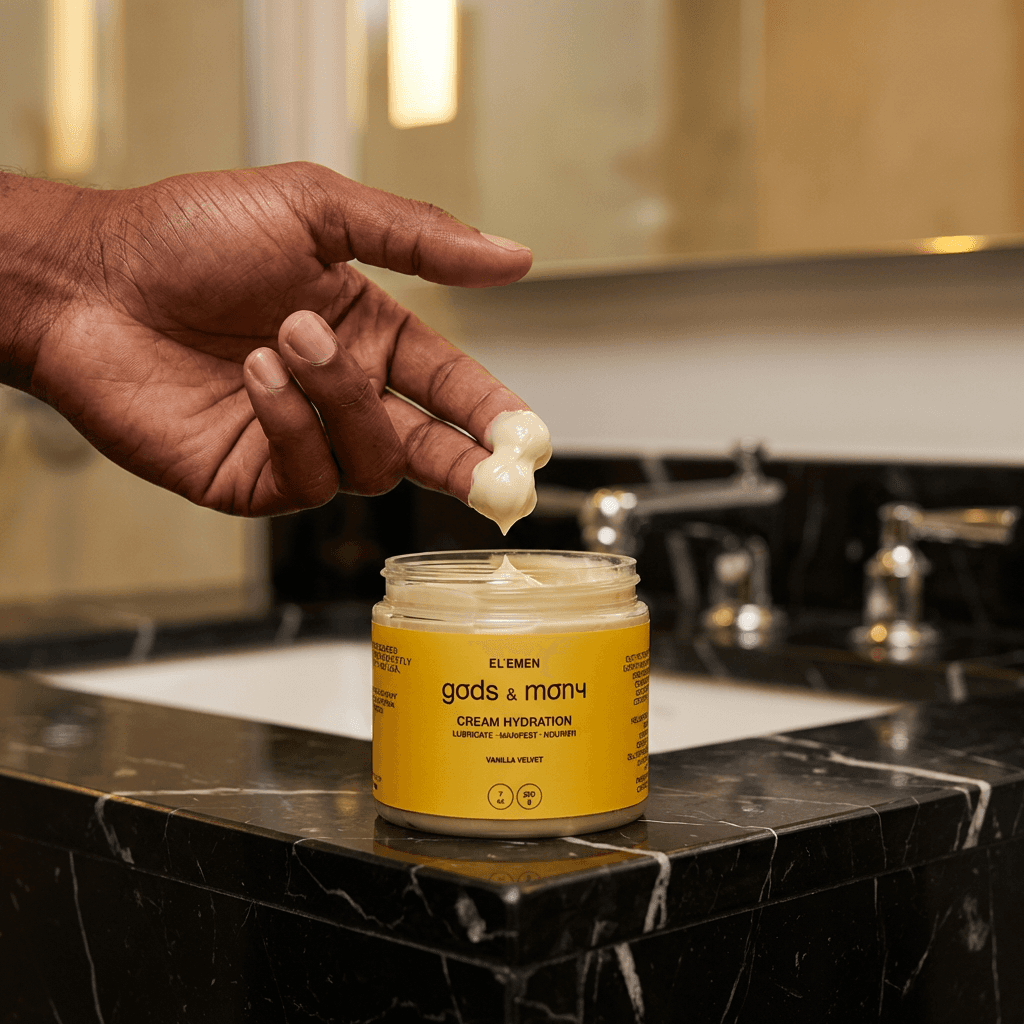
EL'EMEN Creme Hydration seals in what the previous moves prepared. Humectants pull water in. Emollients smooth the surface. Barrier lipids rebuild what shaving and exfoliation temporarily open up. Apply to slightly damp skin. The absorption is different when there's a little moisture to work with.
Dehydrated oily skin produces more sebum to compensate. If your skin gets oilier throughout the day, you're probably not moisturising enough. Not too much. Not enough.
For drier skin or nighttime use, EL'EMEN Moisturizing Oil goes on last at night. It locks in the cream. It works while you sleep. Skin repair and collagen synthesis peak during sleep (Nature, 2025). That's the move you don't see but feel the next morning.
Citation Capsule: Research published in Nature (2025) found that quality sleepers experience approximately 30% better skin barrier recovery compared to poor sleepers. Nighttime moisturisation with a facial oil applied over cream is the highest-leverage recovery window in a mens skincare routine.
The Fourth Move: Block What Ages You
Ninety percent of visible skin aging comes from UV exposure. Not time. UV. (Skin Cancer Foundation, 2024.)
That number should stop you. Because most men are not blocking it. The American Academy of Dermatology's 2025 Practice Safe Sun survey found that 73% of US adults use products or procedures to prevent premature aging, while only 56% use sunscreen regularly, and nearly one in four don't know that sunscreen prevents early aging at all (AAD, May 2025). Men sit at the bottom end of that range: only 12.3% of US men always use sunscreen when outside for more than an hour on a sunny day, and only 18.1% use it on the face regularly versus 29.9% of women (CDC NHIS / ConsumerStyles). That gap is where most premature male aging lives.
Read that first number again. Three quarters of adults are spending money on the aging problem. Barely half are using the one product with the strongest evidence behind it. That is not an information gap. It's an execution gap.
SPF 30 minimum. Broad-spectrum. Every morning. Last product in the sequence, before you leave the bathroom.
UVA penetrates window glass. You're getting dosed at your desk, in the car, standing near any window. Year-round. The man who knows this and still skips SPF has made a choice. Just not an intentional one.
Morning vs. Night: The Same Discipline, Different Direction
Morning protects. Night repairs.
That's the whole framework. Daytime skin defends against UV, pollution particles (PM2.5), and oxidative stress. Nighttime skin rebuilds. Collagen synthesis peaks. DNA damage corrects. The products shift accordingly. Antioxidants and SPF in the morning. Repair and depth at night.
The four moves don't change. The weight and sequencing do.
Morning sequence: Wash Up - Creme Hydration - SPF.
Night sequence: Wash Up - EXFOLIARE (2-3x per week) - Moisturizing Oil or Creme Hydration.
Research shows good sleepers experience approximately 30% better skin barrier recovery and superior UV-damage healing compared to poor sleepers (Nature, 2025). Your night routine isn't just products. It's the prep work for what your body does while you're unconscious.
Step | Morning | Night |
|---|---|---|
Cleanse | HOMME The Wash Up | HOMME The Wash Up |
Exfoliate | Skip | EXFOLIARE, 2-3x per week |
Hydrate | EL'EMEN Creme Hydration | EL'EMEN Creme Hydration or Moisturizing Oil |
Protect | SPF 30+ (mandatory) | Skip |

The First 90 Days: How a Skincare Routine for Men Actually Sticks
A skincare routine for men fails in the calendar, not in the bathroom. Plan for roughly two months before it runs on autopilot, and the odds change completely.
Here is the number nobody selling you a 30-day challenge wants to lead with. A 2024 systematic review and meta-analysis of health-behaviour habit formation, covering 20 studies and 2,601 participants, found that habits take a median of 59 to 66 days to establish, with individual times ranging from 4 to 335 days (Singh et al., Healthcare, 2024). The "21 days" figure that every men's magazine repeats is explicitly called out in that paper as a misconception.
So the man who starts a routine on the first of the month and judges it on the thirtieth is quitting at the halfway point of the median. He didn't fail the routine. He audited it too early.
That same review found two things that matter more than willpower. Habits anchored to a morning cue formed more strongly than habits scattered through the day. And habits the person chose for themselves formed more strongly than habits assigned to them. Both of those are structural advantages, and both are free.
Why This Routine Is Built Around the Morning
The four moves already put your heaviest-leverage work at the front of the day: wash, hydrate, protect. That's not an accident of sequencing. It's the cue that the research says holds.
You already have an unbreakable morning trigger. You wash. You shave. You leave the house. Bolting the routine onto an existing anchor is how a morning routine turns into a standard rather than a resolution. The products sit where you already stand. No decision required at 6:40am, which is exactly when decisions lose.
Night is the harder half, and it's where most men leak. The fix is the same principle in reverse: attach the night moves to the last thing you already do without thinking, whether that's brushing your teeth or setting an alarm. The cue does the work that motivation won't.
The 90-Day Arc
Don't run all four moves from day one. Load them in stages so the habit compounds instead of collapsing.
Window | What you're doing | What you're measuring |
|---|---|---|
Days 1-14 | Two moves only: HOMME The Wash Up twice daily, EL'EMEN Creme Hydration after. SPF every morning. | Nothing. You're building the cue, not chasing a result. |
Days 15-45 | Add EXFOLIARE 2x per week at night. Hold everything else. | Whether you missed a day. That's the only metric that counts. |
Days 46-90 | Full four moves. Add EL'EMEN Moisturizing Oil at night if your skin runs dry. | Photos in consistent lighting, every two weeks. |
Two weeks of two moves beats four weeks of four moves abandoned in week three. The compounding lives in the streak, not the stack.
Missing a Day Is Not the Failure
The failure is treating one missed night as evidence that the whole thing was never for you. The habit-formation literature is unambiguous that occasional lapses don't meaningfully damage habit strength. What damages it is the story a man tells himself afterwards.
This is the same mechanic that runs underneath training, saving, and every other quiet discipline: consistency is a system you design, not a feeling you summon. Design it once and the routine survives the bad weeks.
The Cultural Tailwind Is Real
If part of what's stopping you is the sense that this isn't what men do, the market already answered. US men's grooming sales topped $7.1 billion in 2025, up 6.9% year over year (NielsenIQ, 2025). US prestige beauty grew 4% to $36 billion across 2025, with prestige skincare the fastest-growing category by units sold (Circana, 2025). And among Gen Z men, facial skincare use hit 68% in 2024, up from 42% two years earlier (Mintel, 2024).
That's not a trend. That's a floor moving. The grooming habits that separate men who look put-together from men who don't are now table stakes, not a differentiator. The differentiator is whether yours survives past day 60.
Does Your Skin Type Change the Moves? Yes. Does It Change the Framework? No.
The framework stays the same. The product selection shifts. If you don't know your type, take the 60-second Skin Type Quiz. It changes what you buy. It doesn't change how you think about the routine.
Oily and Acne-Prone
Your skin overproduces sebum. That's not a reason to skip moisturiser. It's a reason to choose a lighter texture. Gel-weight hydration. BHA exfoliation (salicylic acid) 2-3x per week. The EXFOLIARE keeps pores clear. EL'EMEN Creme Hydration balances without sitting heavy.
Dehydrated oily skin compensates by producing more oil. That's the loop most oily-skin men are stuck in.
Dry
Your barrier is under-supported. Use HOMME The Wash Up as your gentle reset, EXFOLIARE once a week, and EL'EMEN Moisturizing Oil at night to lock in what you need. Rich, sustained hydration. Not heavy. Sustained.
Combination
Oily through the T-zone, drier on the cheeks. Most men land here. The moves work as written. No special modifications required.
Sensitive
Go slower. Introduce one new product at a time, two-week observation between additions. Fragrance-free wherever possible. The EXFOLIARE frequency drops to once a week. Mineral SPF (zinc oxide) over chemical filters.
Mature
Cell turnover at 45-60 days (PubMed). That means results take longer. That doesn't mean they don't come. Add a retinol at night, a vitamin C in the morning, and a peptide serum when you're ready to go further. The four moves hold. You're just adding depth inside them.
Skin Type | Wash Up Frequency | EXFOLIARE | Hydration Choice | SPF Priority |
|---|---|---|---|---|
Oily/Acne | 2x daily | 2-3x/week | Creme Hydration | Oil-free formula |
Dry | 1-2x daily | 1x/week | Moisturizing Oil night | Hydrating formula |
Combination | 2x daily | 2x/week | Creme Hydration | Standard |
Sensitive | 2x daily | 1x/week | Creme Hydration | Mineral/zinc |
Mature | 2x daily | 1-2x/week | Oil + Creme layered | SPF 50 |
The Mistakes Men Make (and What They Actually Cost)
Founder's note. In building Gods and Mony, the same five mistakes came up in every conversation with men who'd tried and quit skincare. Not because the routine was hard. Because nobody told them the real cost of each mistake.
Most men don't fail at skincare because the science is complicated. They fail because of five fixable things.
Skipping SPF. 83% of men report no daily sunscreen use (CDC/NHIS-aligned survey data). That's 83% absorbing the thing that drives 90% of visible aging with no shield. The fix is one product, every morning.
Using bar soap on the face. pH 9-10 on skin that runs at 5.0-5.5. That's the mismatch. The tightness after washing isn't clean skin. It's a disrupted acid mantle. Switch to HOMME The Wash Up.
Over-exfoliating. Daily scrubbing, stacking chemical and physical exfoliants, exfoliating after shaving. That's not more results. That's a broken barrier. Two to three times a week. Never on a raw shave day.
Skipping moisturiser because the skin is oily. Explained above. Oily and hydrated are different. Dehydrated oily skin makes more oil. A lightweight formula reduces oiliness over time.
Quitting at week two. Skin cell turnover takes 28-60 days depending on age. Actives need 8-12 weeks. You're not supposed to see the results yet.
How Long Until You See the Results?
Biology sets the timeline. Not marketing.
Hydration changes in days. Texture in weeks. Lines and pigment in months. That's the honest answer. Cell turnover cycles every 28 days at 20, and slows to 60 days by 50 (PubMed dermatology research). Older skin needs more patience. Not more products.
Air pollution (PM2.5) correlates with a 20%+ increase in facial pigment spots in high-concentration urban areas (peer-reviewed dermatology research, PMC). Daily cleansing and antioxidants are the direct counter. That's the case for the morning routine being non-negotiable if you live in a city.
What You're Waiting For | Realistic Timeline |
|---|---|
Hydration and softness | 3-7 days |
Brightness | 2-4 weeks |
Texture improvement | 4-8 weeks |
Acne reduction | 6-12 weeks |
Dark spots and pigment | 8-16 weeks |
Fine lines and collagen | 12-24 weeks |
Take photos in consistent lighting every two weeks. The mirror lies. Photos tell the truth.
Frequently Asked Questions
How many steps should a mens skincare routine have? Four moves. Not steps. Cleanse, exfoliate, hydrate, protect. Beginners can start with three (wash, moisturise, SPF) and add exfoliation once the habit locks in. More complexity doesn't mean better skin. Consistency means better skin. Research confirms results require 8-12 weeks minimum of consistent application.
Should men wash their face in the morning? Yes. Every morning. Overnight your skin produces sebum and sheds dead cells. A proper cleanse removes that buildup and preps the surface for everything that follows. If you have very dry skin, use a gentle formula like HOMME The Wash Up and follow with hydration immediately.
Do men need different skincare than women? Different formulation. Same framework. Men's skin runs 20-25% thicker with higher sebum output and daily shaving stress. Lighter textures, pH-balanced cleansers, and exfoliation calibrated around shave days produce better results than applying women's or unisex products directly. The biology is different. The products should be too.
How often should men exfoliate? Two to three times per week. Never daily. Start at once a week and build based on how your skin responds. Sensitive skin caps at once weekly. Oily skin tolerates 2-3x. Never exfoliate the same day as shaving if your skin is raw. EXFOLIARE is formulated to give you the result without the over-strip.
Is SPF really necessary every day, even indoors? Yes. UVA rays penetrate window glass. They're the long-wave radiation responsible for photoaging - roughly 90% of visible skin aging according to the Skin Cancer Foundation (2024). Blue light from screens adds oxidative stress on top of that. Daily SPF 30+ minimum, every morning, is the highest-ROI move in the entire routine. It's also the most skipped: 73% of US adults use something to prevent premature aging, but only 56% use sunscreen regularly (American Academy of Dermatology, 2025).
What do you actually need to start a skincare routine? Three things: a pH-balanced cleanser, a moisturiser, and an SPF 30+. That's the entire entry cost. HOMME The Wash Up and EL'EMEN Creme Hydration cover the first two, and any broad-spectrum SPF covers the third. Exfoliation is the fourth move, not the first - add EXFOLIARE once washing and moisturising happen without you thinking about them, usually around week three. Buying five products on day one is the most common way men guarantee they'll be using none of them by day thirty.
How do you build a skincare routine for men with a beard? The moves don't change. The technique does. Work the cleanser down to the skin underneath the beard rather than lathering the hair, because the buildup that causes itch, flaking, and beardruff sits at the follicle, not on the surface. Moisturise the exposed skin - cheekbones, forehead, neck - and then apply EL'EMEN Moisturizing Oil through the beard itself at night, which conditions the hair and the skin under it in one pass. Exfoliate the shaved or short-stubble areas only. And SPF still applies: a beard is not sunscreen, and the hairline, ears, and neck stay fully exposed.
How long does it take for a skincare routine to become a habit? A median of 59 to 66 days, according to a 2024 systematic review of 20 habit-formation studies covering 2,601 participants (Singh et al., Healthcare, 2024). Individual times ranged from 4 to 335 days. The popular "21 days" claim is explicitly identified in that research as a myth. Practically: judge the routine at day 90, not day 30, and anchor it to a morning cue you already have, because morning-anchored and self-chosen habits formed the strongest in the data.
The Manifesto
Skin doesn't lie.
It shows the sleep you skipped. The hydration you didn't give it. The sun you let run unchecked for twenty years. It shows the consistency too. The mornings you showed up. The discipline that compounded quietly while no one was watching.
A mens skincare routine isn't vanity. It's maintenance. It's the same logic as training, as diet, as sleep. You protect what you want to keep.
The four moves aren't complicated. They never were. Wash it clean. Clear the surface. Lock in hydration. Block what ages you. Four products. Four moves. Done in four minutes. Every morning. Every night.
The man with clear, composed skin isn't using more. He's using the right things consistently. That's the whole secret. It is also, for what it's worth, the cheapest way a man can look expensive - no wardrobe required.
Decided men build the routine here. Or take the quiz and let us tell you exactly where to start.
Related Reading
Not sure where your skin is right now? Take the 60-second Skin Type Quiz and get a personalised routine built around where you're starting.

Gods and Mony Editorial
Editorial Team
Next posts