When he already owns everything, the last gift left is permission to slow down.
Gifts for the Man Who Has Everything (But Never Slows Down)
14 min read
July 12, 2026

Gifts for the Man Who Has Everything (But Never Slows Down)
He has the watch. The jacket. The second pair of the same shoes in a different colour because the first pair was that good. Ask him what he wants and he says "nothing, I'm fine" — and he means it, which is exactly the problem.
The man who has everything is the hardest man to buy for because you're solving the wrong equation. You keep looking for an object he doesn't own yet. There isn't one. Or if there is, it's a marginal upgrade to something he already has, and he'll be gracious about it and it'll sit in a drawer.
Here's the reframe that changes everything: when a man already owns every thing, the one gift he's still missing isn't a thing at all. It's permission. Permission to slow down. A reason to stop. Ten minutes a day that belong to him and nothing else. A ritual that's his. If you are shopping specifically for the holidays, our guide to luxury Christmas gifts for men applies the same logic to the season, favouring a better version of a daily ritual over yet another object he does not need.
This is a guide to giving that. Not a listicle of expensive objects he'll politely accept. A different way of thinking about what "having everything" actually leaves a man without — and how a small, well-chosen ritual outperforms a big, forgettable purchase every single time.
The man who has everything is missing one thing: a reason to stop
Look at the man you're buying for. He's capable. Probably driven. He handles things. He's the one people call when it needs to get done.
Men like that don't have a possessions problem. They have a permission problem.
The relentless, capable man has quietly organised his entire life around output. Every hour is accounted for. Downtime feels like something to apologise for. He'll tell you he's "just busy," and he is, but underneath the busy is a belief he'd never say out loud: that stopping is soft, that maintenance is indulgent, that he'll rest when the work is done. The work is never done.
This matters more than it sounds. Men are quietly more isolated than they let on: the share of men with no close friends rose fivefold between 1990 and 2021, from 3% to 15% ([Survey Center on American Life, via the American Institute for Boys and Men](https://aibm.org/research/male-loneliness-and-isolation-what-the-data-shows/)), and only 38% of men say they'd be very likely to turn to a friend for emotional support, versus 54% of women ([Pew Research Center, 2025](https://www.pewresearch.org/social-trends/2025/01/16/men-women-and-social-connections/)). The capable man is often the loneliest man in the room, precisely because he's the one holding everyone else up — and the least likely to ask for anything back.
So when you're standing in a store looking for the best gift for a man who has everything, understand the actual brief. You're not filling a gap in his closet. You're giving him a reason — and the permission — to stop for a few minutes and take care of himself. That's the thing he genuinely doesn't have. That's the thing he'd never buy for himself.
Why "one more thing" doesn't land — and a ritual does
There's a strong body of research explaining why the expensive object underwhelms and the small experience sticks.
Research by Cindy Chan and Cassie Mogilner found that experiential gifts strengthen relationships more than material ones — and that the effect comes from the intensity of emotion a person feels *while using* the gift, not from unwrapping it together ([Chan & Mogilner, *Journal of Consumer Research*, 2017](https://academic.oup.com/jcr/article/43/6/913/2632328)). A new gadget is one spike of feeling that fades to background by month two. A ritual is a small hit of that same feeling every single day.Gift-givers also systematically misread what recipients value. Behavioural research summarised by the Yale School of Management shows that givers chase impressive, expensive, attractive gifts, while recipients feel most cared-for by gifts that are thoughtful and actually fit their lives — a plain, practical, requested item can signal more care than a flashy one ([Yale School of Management, 2022](https://som.yale.edu/story/2022/behavioral-scientists-guide-gift-giving)). Translation: the man who has everything is not waiting to be impressed. He's waiting to be *seen*.
That's the whole game. A ritual gift says something an object can't: I noticed you never stop. I want you to. It's specific to him. It repeats — every morning, every night, it's there, and every time it quietly reminds him that someone thought about his wellbeing, not his wishlist.
An expensive object is a full stop. A ritual is a sentence he gets to finish himself, over and over.
The six-month test: what he'll actually still be using
Here's a filter that cuts through every gift guide you'll read this season. Before you buy anything for the man who has everything, ask one question: will he still be using this in six months?
Run the usual suspects through it. The premium gadget: used hard for two weeks, then it joins the graveyard of other premium gadgets in the drawer. The designer accessory: worn twice, admired, shelved. The experience voucher: a lovely day out, over by dinner, a nice memory that doesn't repeat. The bottle of something top-shelf: gone by February, and then it's just a memory of a bottle.
Now run a ritual through it. A grooming routine he actually likes doesn't get used up and forgotten — it gets absorbed. It becomes the thing he reaches for on autopilot every morning, the step he'd now notice if it were missing. Six months later it isn't a gift anymore; it's part of how he starts his day. That's the difference between a present and a fixture.
This is exactly what the experiential-gift research predicts. Because the value of a ritual lives in the emotion felt during use rather than at the moment of unwrapping, it doesn't decay the way an object does — every use is a fresh, small hit of the same good feeling. The object peaks at the bow and declines from there. The ritual is roughly as good on day 180 as it was on day one, which over six months is not a close contest.
So when you're weighing an impressive one-off against a modest daily ritual, the maths is simpler than it looks. One gives him a great afternoon. The other gives him a better morning, every morning, until he forgets it was ever a gift at all. For a man who already has everything, that repetition is the entire point.
The self-care gift men actually keep using
Here's the practical problem with "give him a ritual": most men won't build one for themselves. Not because they don't want to feel good, but because they've been quietly taught that grooming and self-care are optional, vain, or someone else's category.
That's changing fast. U.S. men's grooming reached $7.1 billion in sales in 2025, up 6.9% year over year, with 60% of men buying grooming products specifically to maintain their appearance over time ([NielsenIQ, 2025](https://nielseniq.com/global/en/insights/report/2025/mens-grooming-market-surges-key-trends-you-need-to-know/)). But men still lag on the reason that matters most here: women are markedly more likely than men to pursue self-care to manage stress (57%) and for mental and emotional wellbeing (56%) ([YouGov, 2024](https://yougov.com/en-us/articles/50132-32-of-us-adults-engage-in-daily-self-care-practices)). Men are buying the products. Far fewer are giving themselves the permission — the gap between owning a routine and actually *using* one someone handed them, unwrapped, no decisions required.
That gap is where the gift lives.
This is why a considered grooming ritual is the single best gift for a man who has everything: it removes the friction he'd never push through on his own. You're not asking him to research anything, choose anything, or admit he wants it. You're handing him the finished thing. The bar of entry is a shower he was going to take anyway.
Start where the day already starts. [HOMME The Wash Up](https://godsandmony.com/products/homme-the-wash-up-skin-wash) turns the most ordinary two minutes of a man's morning into the one part of the day that's unmistakably his — a clean, organic, USA-made body wash that feels like a standard, not a treat. For the man who "doesn't need anything," this is the gift he doesn't realise he's been missing until it's on the shelf and the morning feels different.
If you want to build it into something fuller, that's where the ritual deepens.

How to build a ritual gift he won't quietly regift
A good ritual gift has three qualities: it's low-friction, it repeats, and it upgrades something he already does. Here's how to assemble one for the man who has everything, in order of how deep you want to go.
Level one: the two-minute upgrade
Give him one thing that improves a moment he can't skip. The shower is the obvious one — everyone showers. HOMME The Wash Up makes that non-negotiable moment feel intentional. One product, zero learning curve, immediate difference. This is the entire gift, and it's enough. Most people over-complicate from here.
Level two: the morning and the night
Add the bookends. A man who has everything responds to structure, so give his day two clean edges.
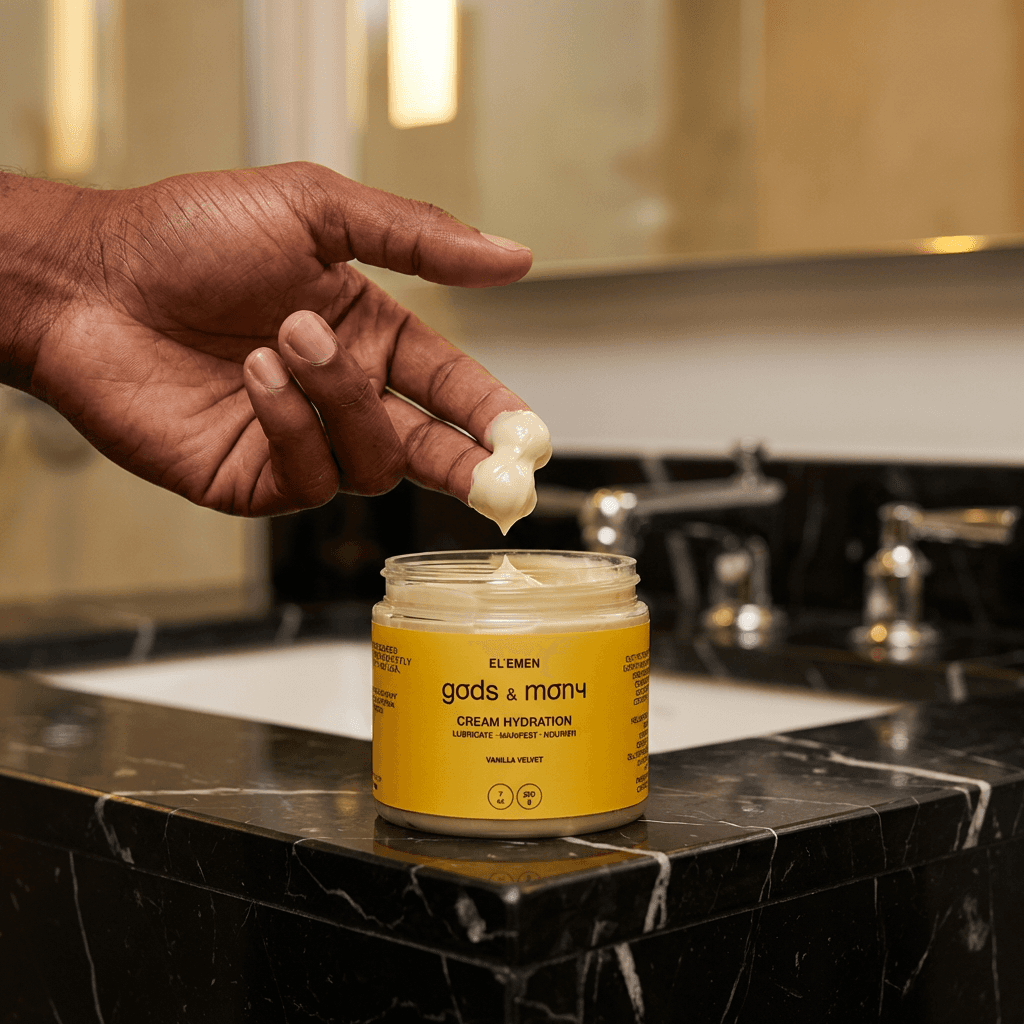
Morning: a proper cleanse and a hydrating finish so he walks out of the bathroom looking like he slept eight hours whether or not he did. EL'EMEN Creme Hydration does the heavy lifting here — a moisturiser that reads as maintenance, not fuss.
Night: a slower step. EL'EMEN Moisturizing Oil turns the last few minutes before bed into a genuine wind-down — the physical act of slowing down that his brain has forgotten how to do on command.
Two products, two edges of the day, a rhythm he'll fall into without being asked. If he has a partner, this is also the easiest shared ritual there is — the same logic behind a couples self-care routine, just started one man at a time.
Level three: the full reset
Once a week, give him the deeper version — the equivalent of a factory reset for skin that's spent five days in air conditioning, travel, and stress. EXFOLIARE Exfoliant is the Sunday-night ritual: the thing that makes the whole week's routine visibly pay off, and the step that feels most like an actual treat.
You don't need all three levels. The genius of the ritual gift is that level one already works. Everything above it is you deciding how much of his day you want to quietly make better.
If you'd rather hand him the whole thing pre-assembled, the bundles and gift sets do exactly that — the ritual, boxed, no decisions required. Or if you genuinely don't know where his skin sits, the two-minute skin quiz builds the recommendation for you.
For the women buying for the men in their lives
A lot of you reading this are women buying for a man who insists he needs nothing. Partner, husband, father, brother, the guy who's impossible every December. This section is for you, because you're often the one who notices the thing he won't.
You already see it. He runs on fumes and calls it fine. He'd never spend twenty dollars on himself for something that isn't strictly necessary, but he'll drop hundreds on the family without blinking. He treats his own maintenance as the lowest priority on a list that never ends.
A self-care gift, from you, does something a man almost never does for himself: it gives him permission he'd never grant himself. It's not the product — it's the message underneath it. I see how hard you go. I want you to take care of yourself the way you take care of everyone else. (If you want the deeper version of this, our guide to self-care gifts for men unpacks why the gift is really permission, not product.)
And there's a quieter benefit. Shared ritual is connection. When self-care becomes something you both do — the two-minute wind-down, the Sunday reset — it stops being a solo chore and becomes a small pocket of the relationship. The experiential-gift research is blunt about this: experiences build relationship strength in a way objects don't, through the emotion felt while sharing them (Chan & Mogilner, 2017). You're not just buying him a body wash. You're building a thirty-second ritual you can share.
What this looks like across the men in your life
The ritual framework scales to whoever's impossible to buy for.
The executive who has everything: he responds to quality and restraint, not novelty. Give him the morning-and-night routine — understated, premium, the kind of thing he'd never source himself but will use every day.
The father who "doesn't want anything": he's spent decades putting himself last. The gift here is explicit permission to stop doing that. A gift set makes the message unmissable.
The friend who's burning out: he needs a reason to decompress that isn't a screen. The night-time oil is a physical off-switch for a mind that won't stop.
The younger man building himself: he's already primed for this. Give him the full ritual early and he'll carry the standard for years.
None of these are about the object. All of them are about the same thing: handing a capable man a reason to take care of himself, wrapped in a way he can accept without feeling like he asked.
The best gift for a man who has everything
Stop looking for the thing he doesn't own. He owns everything. That search has no answer.
Give him the thing he'd never buy himself instead: a small, daily, low-friction ritual that says slow down, you've earned this, someone noticed. An object is a moment. A ritual is a message he receives every single morning, in the one part of the day that finally belongs to him.
That's the gift for the man who has everything. Not more. Better.
Explore the full skincare collection, build a ready-made ritual from the bundles and gift sets, or take the two-minute skin quiz to match him precisely.
Frequently asked questions
What do you get a man who says he doesn't need anything?
Give him something he'd never buy for himself but will use every day — a self-care ritual. Men who "don't need anything" usually mean they don't need more possessions, but they rarely invest in their own maintenance. A considered grooming routine like HOMME The Wash Up upgrades a moment he can't skip (the shower) and gives him permission to slow down — the one thing he's genuinely missing.
Are experiences really better gifts than objects for men who have everything?
Broadly, yes. Research by Chan and Mogilner found experiential gifts strengthen relationships more than material ones, driven by the emotion a person feels while using the gift rather than a one-time unwrap (Chan & Mogilner, 2017). A daily ritual is a repeated experience — which is why a small grooming routine outperforms a one-off expensive object for a man who already owns everything.
Why does a self-care gift work better than something expensive?
Because thoughtfulness beats price. Behavioural research shows recipients value how well a gift fits their real life over how impressive or costly it is (Yale School of Management, 2022). A man who has everything can buy any object himself — what he can't easily give himself is permission to slow down and take care of his own wellbeing. A self-care gift delivers exactly that.
What's a good self-care gift for a husband who has everything?
Build him a ritual with two edges: a morning cleanse and hydrate (HOMME The Wash Up plus EL'EMEN Creme Hydration) and a slower night-time step (EL'EMEN Moisturizing Oil). Or hand it over pre-assembled with a gift set. The message underneath — take care of yourself the way you take care of us — is the actual gift.
How do I give a man a grooming gift without it feeling like criticism?
Frame it as permission, not correction. You're not telling him he needs to fix something — you're handing him a small luxury he'd never justify buying himself. Lead with the ritual and the reason ("you never slow down; this is ten minutes that are just yours"), not the product. A premium, no-decisions-required gift set makes it read as care, not commentary.

Gods and Mony Editorial
Editorial Team
Next posts