Consistency isn't a feeling you wait for. It's a system you build and a standard you keep.
How to Be Consistent: The Skill That Beats Talent, Motivation, and Luck
18 min read
2026-07-16

In This Article
What consistency actually is (and why it beats talent)
Why you're not consistent (it isn't willpower)
The 66-day truth: how long consistency really takes
Motivation is a liar. Systems don't need you to feel like it.
Build the identity, not just the goal
Start absurdly small: the 1% that compounds
The keystone habit: pick one domino
Make it a ritual you can't skip
When you break the streak (and you will)
Consistency is a standard, not a mood
Frequently Asked Questions
How to Be Consistent: The Skill That Beats Talent, Motivation, and Luck
Ask most men why they haven't gotten where they want to go, and they'll tell you they lack discipline, or focus, or time. That's rarely the real problem. The real problem is that they can do almost anything for three days and almost nothing for three hundred.
Consistency is the quiet skill nobody puts on a highlight reel. It doesn't trend. It doesn't feel impressive in the moment. But it is the single variable that separates the man who talks about the life he wants from the man who is quietly, unglamorously building it. Talent gets you noticed. Motivation gets you started. Consistency is the only thing that actually gets you there.
Here's the part most advice skips: consistency is not a personality trait you either have or don't. It's not about being born with more grit. It's a set of systems, decisions, and identity shifts that any man can install. You don't become consistent by wanting it more. You become consistent by building a life where showing up is the path of least resistance.
This is how you do that.
What consistency actually is (and why it beats talent)
Consistency is the ability to keep doing a thing when the novelty is gone, the mood is off, and no one is watching. That's it. Not intensity. Not perfection. Repetition, held over time, especially on the days you don't feel like it.
We overrate talent because talent is visible and consistency is invisible. You see the finished physique, the built business, the effortless presence, and you assume the man had something you don't. What you don't see are the ten thousand ordinary mornings that produced it. The talent was real. But talent that shows up twice a month loses, every time, to average ability that shows up daily.
The reason consistency wins is compounding. A small action repeated doesn't add up in a straight line, it multiplies. Author James Clear frames it with a simple piece of arithmetic: get one percent better every day for a year and you end up roughly thirty-seven times better than where you started, because 1.01 to the power of 365 is about 37.8 (James Clear, Atomic Habits). Clear borrowed the idea from Sir Dave Brailsford, the cycling coach who turned British Team Sky into a dynasty by chasing the "aggregation of marginal gains" — tiny improvements stacked relentlessly. The exact multiple is a metaphor, not a lab result. But the direction is the whole point: consistency turns small into enormous, and inconsistency turns enormous into nothing.
The man who trains hard for two weeks in January and quits has technically done more work in those two weeks than the man doing twenty minutes a day. Six months later it isn't close. Volume that stops is just a memory. Volume that repeats is a life.
Why you're not consistent (it isn't willpower)
Most men diagnose their inconsistency as a willpower problem. "I just need more discipline." So they white-knuckle it, run on motivation and force, and burn out inside a month. Then they blame themselves. The self-blame is the most damaging part, because it's built on a myth.
For years, psychology taught that willpower was a finite fuel tank — a resource called "ego depletion" that drained with every hard choice until you had nothing left to resist the couch. It's an intuitive story. It's also largely fallen apart under scrutiny. A major preregistered replication run across twenty-three separate laboratories with 2,141 participants failed to reproduce the ego-depletion effect, finding it negligible (Hagger et al., Perspectives on Psychological Science, 2016). The willpower tank you keep blaming may not work the way you were told at all.
That matters because if consistency depended on a willpower reserve you're constantly running low on, you'd be doomed. You're not. The men who look disciplined aren't grinding through a daily war of self-control. They've done something smarter: they've removed the war. They've arranged their environment, their schedule, and their identity so the right action requires almost no willpower to begin with. They don't out-muscle temptation every morning. They just don't invite it into the room.
So stop asking "how do I get more willpower?" It's the wrong question, built on a broken model. The right question is: how do I design a life where the thing I want to do consistently is the easy thing to do?
The 66-day truth: how long consistency really takes
One reason men quit is that they expect the new behavior to feel automatic far too soon. Someone told them it takes twenty-one days to build a habit, so when day twenty-two still feels like a fight, they conclude they're broken and stop.
The twenty-one-day figure is a myth with no real evidence behind it. The actual number, from a University College London study that tracked ninety-six people forming a daily habit, was a median of 66 days for a behavior to become automatic — with an individual range running from 18 days to 254 (Lally et al., European Journal of Social Psychology, 2010). And that finding has only strengthened. A 2024 systematic review and meta-analysis pooling twenty studies and 2,601 participants put habit formation at a median of around 59 to 66 days, with variation stretching from 4 days to 335 depending on the person and the behavior (Singh et al., Healthcare, 2024).
Read that range again: up to 254, even 335 days. For some men, some habits take the better part of a year to feel like second nature. That isn't a sign you're failing. That's the normal shape of the work. The men who make it aren't the ones for whom it clicked fast. They're the ones who kept going through the stretch where it hadn't clicked yet.
There's a quieter gift in that same 2024 research, too: self-chosen habits and morning habits formed more strongly than assigned or evening ones. What you decide to do, done early, sticks harder than what you're told to do, squeezed in late. Which tells you where to put the thing that matters most — at the front of the day, on your own terms.
Motivation is a liar. Systems don't need you to feel like it.
Motivation is real, but it's a terrible foundation, because it's a feeling — and feelings are weather. Some mornings you wake up ready to conquer. Most mornings you don't. If your consistency is contingent on feeling motivated, then your entire life is at the mercy of your mood, and your mood does not have your best interests at heart.
The men who stay consistent for years have quietly stopped negotiating with motivation. They don't wake up and ask whether they feel like training, writing, praying, or showing up. The decision was made a long time ago and taken off the table. There's no daily debate to lose. This is the shift from goals to systems: a goal is the result you want, a system is the set of repeatable actions you run whether or not you feel inspired. Goals are for direction. Systems are what actually move you.
A system doesn't ask for enthusiasm. It asks for a time, a place, and a trigger. You train at 6am because that's when you train. You read for ten minutes when your coffee is brewing because that's the cue. You wash up and reset at night because that's what closing the day looks like. None of it requires you to want it. It just requires you to have built it once and then stopped renegotiating.
Motivation, when it does show up, is a nice tailwind. Use it to build the system, not to run it. Because the system is what carries you on the ninety percent of days when the tailwind is nowhere to be found.

Build the identity, not just the goal
Here's the deepest lever, and the one almost nobody pulls: consistency is easiest when the behavior becomes part of who you believe you are.
Most men try to change from the outside in. They chase an outcome — lose the weight, build the business, get lean — and treat the daily actions as a toll they pay to get there. The problem is that outcome-driven effort has an expiry date. The moment the goal feels far away, or you hit it and there's no next number, the reason to show up evaporates.
Identity-driven effort doesn't expire, because it isn't about a finish line. It's about being a certain kind of man. "I'm trying to work out more" is a goal, and goals are fragile. "I'm the kind of man who trains" is an identity, and identity is self-reinforcing. When training is simply what a man like you does, skipping it isn't a small failure of willpower — it's a small betrayal of who you are. That's a far stronger fence than motivation ever builds.
Every time you show up, you're not just logging a workout or a page or a clean morning. You're casting a vote for the identity of a man who does this. Miss once and nothing collapses. But string those votes together and, at some point, you stop having to convince yourself. You've become the person. The behavior isn't something you force anymore. It's just what you do, because it's who you are.
This is why the small stuff matters more than it looks. The man who keeps his word to himself about a two-minute morning ritual is rehearsing the exact same muscle he'll need to keep his word about the two-year mission. Consistency in the trivial is training for consistency in the significant. It's all the same skill.
Start absurdly small: the 1% that compounds
The single biggest reason men fail at consistency is that they start too big. Fired up, they commit to an hour a day, a total overhaul, a new man by Monday. It works for four days. Then real life shows up — a bad night, a heavy week — and the enormous new commitment is the first thing to go. All or nothing almost always resolves to nothing.
The fix is to start so small it feels almost embarrassing. Not thirty minutes of reading — one page. Not an hour at the gym — put your shoes on and go. Not a full grooming overhaul — wash your face properly, once, tonight. The goal at the start is not results. The goal is to make the streak unbreakable by making the bar impossible to miss, even on your worst day.
This is the logic behind marginal gains: you're not trying to be impressive today, you're trying to still be doing it in six months, because that's where the compounding lives. A tiny action you never skip beats a heroic one you can't sustain, every single time. Once the behavior is automatic — once it costs you no willpower to begin — you scale it. One page becomes a chapter. The walk becomes the workout. But you earn the right to scale by first proving, over weeks, that you show up at all.
Men resist this because small doesn't feel manly. It feels like it's beneath them. But there's nothing impressive about a grand plan that dies in a fortnight. The discipline is in the restraint — in doing less than you're capable of, on purpose, so that you can keep doing it long after the men who went big have quit.
The keystone habit: pick one domino
Not all habits are equal. Some are just habits. A few are keystone habits — the ones that, once in place, quietly pull a dozen other good behaviors along behind them. Get the keystone right and you don't have to fight twelve separate battles for discipline. You fight one, and the rest start falling into line on their own.
The idea comes from Charles Duhigg's The Power of Habit, but the evidence is older and real. Researchers put previously inactive adults through a two-month exercise program and measured effects far outside the gym: participants spontaneously ate better, smoked and drank less, spent more carefully, and scored higher on lab measures of self-control they were never explicitly training (Oaten & Cheng, British Journal of Health Psychology, 2006). They came for the workouts. They left with a stronger will across their entire lives. One consistent domino tipped the rest.
That's what you're looking for when you're learning how to be consistent: not a to-do list of ten new habits, but the one or two that make everything else easier. For most men it's some combination of training, sleep, and a daily ritual that anchors the day. Nail the keystone first. Let it do the heavy lifting. Trying to fix everything at once is exactly how men end up fixing nothing.
Make it a ritual you can't skip
Systems and identity are the strategy. A ritual is how you make it physical, daily, and hard to talk yourself out of.
A ritual is a small sequence of actions, tied to a fixed cue, that runs the same way every time. It's the difference between "I should probably take better care of myself" — vague, negotiable, easily skipped — and a specific two minutes that happen in the same place, at the same point in your day, until skipping them feels wrong. The cue does the remembering so your willpower doesn't have to. The repetition does the rest.
The most reliable place to anchor a keystone ritual is the part of your day that already happens no matter what: the shower, the first hour, the wind-down before bed. You're not adding a new slot to a crowded schedule. You're upgrading a moment you were going to spend anyway. That's why grooming is such an underrated keystone for men — it's daily, it's non-negotiable, and done with intent it becomes the small, repeatable win that sets the tone for everything after it.
This is exactly where a considered wash-up earns its place. [HOMME The Wash Up](https://godsandmony.com/products/homme-the-wash-up-skin-wash) turns the most ordinary two minutes of your morning into a deliberate reset — a clean, organic, USA-made body wash that makes the start of the day feel like a standard you keep, not a chore you rush. It's the kind of small, daily rep that quietly trains the same muscle you'll need for everything bigger.
There's real ground to make up here. Only about 29% of men report having a skincare or grooming routine at all, versus 62% of women, and just 11% of men keep a daily one, compared with 32% (CivicScience, 2023). Most men aren't inconsistent because they don't care. They're inconsistent because they never built the ritual. The men who do have a quiet daily advantage — a fixed, reliable win banked before the day even makes its demands.
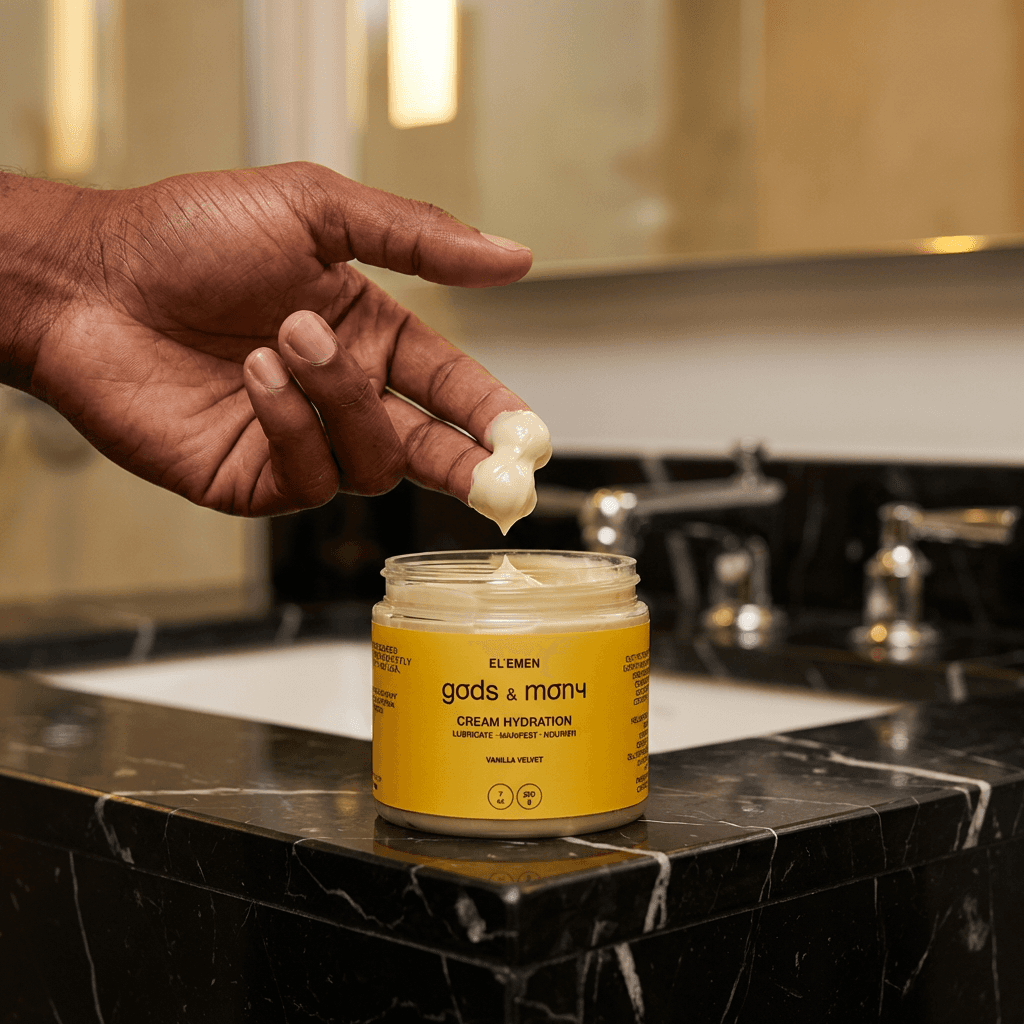
Build it out from there without over-complicating it. A twice-weekly reset with [EXFOLIARE Exfoliant](https://godsandmony.com/products/exfoliare-exfoliant) and a daily finish with [EL'EMEN Creme Hydration](https://godsandmony.com/products/el-emen-creme-hydration) turn "take care of yourself" from a vague intention into a fixed, three-part routine you actually run. Not because the products are the point — because a routine with defined steps is a hundred times more repeatable than a good intention with none. You can see the whole [skincare lineup here](https://godsandmony.com/collections/skincare), or take the [two-minute quiz](https://godsandmony.com/quiz) if you want the shortest path to a routine that fits your skin.
When you break the streak (and you will)
You are going to miss. A trip, an illness, a brutal week, a day that simply gets away from you. Every consistent man in history has broken his own streak. The difference between them and everyone else isn't that they never miss. It's what they do the next day.
The rule that protects consistency better than any other is simple: never miss twice. One missed day is an accident. Two is the beginning of a new, worse pattern. Missing once costs you almost nothing — the habit is intact, the identity is intact, you just skipped a rep. It's the second, third, and fourth misses that quietly rewrite who you are back into a man who doesn't do this anymore. So when you break the chain, the only thing that matters is getting back to it immediately, without the spiral of guilt that usually follows and finishes the job.
You can watch this play out at scale in the world's most successful consistency engine. Duolingo built an entire product around the daily streak, and it works precisely because the streak becomes an identity people protect: the company reports that over ten million of its users hold a streak of a year or longer (Duolingo Q4 2024 shareholder letter). Those people aren't more motivated than you. They just have a chain they refuse to break, and a system built to make getting back on easy. That's the whole trick. Not perfection. Repair.
Drop the fantasy of the flawless run. Nobody gets it. Trade it for something far more durable: the man who always comes back. That man is unstoppable, not because he never falls off, but because falling off has stopped meaning anything.
Consistency is a standard, not a mood
Here's what all of it comes down to. Consistency isn't a burst of discipline you summon on your best days. It's a standard you hold on your worst ones. It's what you do when the excitement is gone, the audience has left, and the only person who'd know if you quit is you.
Most men are waiting to feel ready, motivated, inspired — waiting for a version of themselves that shows up on its own. He isn't coming. What's available instead is better: a system small enough to survive your worst day, an identity worth voting for, one keystone that pulls the rest along, and the discipline to come back the day after you fall off. That's not glamorous. It's just how it's actually done.
Talent is common. Motivation is cheap and unreliable. Luck is out of your hands. Consistency is the one thing fully within your control, and it happens to be the one that decides everything. Build the system. Keep the standard. Show up on the days it would be easiest not to.
That's the whole game. And the man who plays it long enough stops competing with anyone else. He's the only one still standing.
Frequently Asked Questions
How long does it actually take to become consistent at something? Longer than the popular "21 days" myth suggests. The research points to a median of around 66 days for a behavior to become automatic, with a genuine range from about 18 days to 254 or more depending on the person and the habit (Lally et al., 2010; Singh et al., 2024). Expect it to feel effortful for weeks before it feels natural. That stretch is normal, not a sign of failure.
Why can I start things but never stay consistent? Because you're relying on motivation and willpower, both of which are unreliable — the "willpower as a fuel tank" model has largely failed to replicate (Hagger et al., 2016). Starting runs on excitement, which fades fast. Staying runs on systems: a fixed time, a clear cue, and a bar small enough to clear on a bad day. If you keep quitting, your habits are almost certainly too big and too dependent on how you feel.
Is consistency more important than intensity? Yes, over any meaningful timeframe. Intensity that stops is just a memory; a smaller action repeated compounds. A short daily effort held for a year beats an all-out push that burns out in three weeks, because the results live in the repetition, not the peak.
What's the fastest way to become more consistent? Start absurdly small, anchor the habit to something you already do every day, and make it about identity rather than outcome. Pick one keystone habit instead of overhauling everything at once, and follow one rule when you slip: never miss twice. Getting back the next day matters more than never missing.
How does a grooming routine help with consistency? It's an ideal keystone habit — daily, quick, and tied to something you already do (showering). A fixed two-minute ritual banks a reliable win before the day makes its demands, and keeping that small promise to yourself trains the same discipline you'll use for bigger goals. Research on keystone habits shows one consistent behavior can strengthen self-control across unrelated areas of life (Oaten & Cheng, 2006).
Consistency is the quiet engine behind everything Gods and Mony makes — clean, organic, USA-made grooming built to be a standard you keep, not a treat you reach for. Explore the full skincare collection, or read more on how to build discipline, how to stay motivated, and how to be mentally strong.

Gods and Mony Editorial
Editorial Team
Next posts