Where LA culture meets quiet luxury. The wardrobe, skin, and standards of men who never announce themselves.
Old Money Style Men: How to Carry Wealth Without Announcing It
13 min read
2026-05-15

In This Article
Old Money Style Is Not a Look. It's a Posture.
The Tenth of a Second That Decides Everything
Quiet Luxury Is Not a Trend. It's a Correction.
The Skin Is the First Suit
The Wardrobe: Five Anchors, Not Fifty Pieces
The Grooming Ritual Behind the Look
What Old Money Men Never Wear
The LA Version of Old Money
Buy Less. Buy Better. Wear Forever.
Frequently Asked Questions
Old Money Style Men: How to Carry Wealth Without Announcing It
Old money doesn't dress to be seen. It dresses to be remembered.
There's a difference. New money walks into the room and points at itself. Old money walks in and the room rearranges. No logos. No flash. No proof needed.
Most men think old money style is a wardrobe. A navy blazer. A pair of loafers. A linen shirt. They buy the costume and wonder why it still looks like a costume.
The clothes were never the point. The man underneath was.
This is how you become him.
Old Money Style Is Not a Look. It's a Posture.
Most men chasing old money style get it backwards. They start with the clothes. They should start with the man.
Old money isn't a price tag. It isn't a brand. It isn't even an income bracket. It's a posture. A way of moving through the world that says "I don't need you to know."
You can't fake that posture with a coat. You build it with discipline. With rituals nobody sees. With standards you hold yourself to in private that the world only reads in the silence after you leave.
The wardrobe is downstream of the man.
Look at the men who genuinely carry this energy. They aren't loud. They don't perform. They don't explain. They walk in, do the work, and leave. The clothes are background music. The man is the song.
So when you build the look, build the man first. Then dress him.
The Tenth of a Second That Decides Everything
Princeton researchers Janine Willis and Alexander Todorov ran a study that should change how you walk into every room for the rest of your life. They flashed photographs of strangers for 100 milliseconds. One tenth of one second. Then asked people to rate trustworthiness, competence, and status.
The judgments made in 100 milliseconds matched the judgments made with unlimited time.
Longer looks didn't change the verdict. They just made people more confident in it.
Read that again. The first impression isn't formed in seven seconds. It's formed in a hundred milliseconds. By the time someone consciously notices you, the decision is already locked.
This is why old money men obsess over the surface most men ignore. Skin tone. Posture. Cut of the shirt at the shoulder. The watch you didn't show. The shoes nobody complimented but everybody clocked.
They aren't being vain. They're being efficient.
The first hundred milliseconds is the only window you control without speaking. Old money owns that window.
Quiet Luxury Is Not a Trend. It's a Correction.
The market is moving. Hard.
Google searches for "quiet luxury" jumped 614% year-over-year. "Stealth wealth" climbed 990%. "Old money style" rose 874%. Pinterest searches for the aesthetic are up over 40% in 2025 alone.
Something is happening, and it's bigger than a fashion cycle.
Bain & Company's 2025 luxury report found the luxury market lost roughly 20 million active consumers in 2025. The ones who stayed shifted their spending from logos to experiences, from flash to craftsmanship, from announcement to authenticity. Over 60% of luxury buyers reported buying fewer items because the quality no longer justified the price.
This is the correction. The men who can actually afford luxury are quietly walking away from the loud version of it.
What they're walking toward is older. Quieter. Built on cut, cloth, and presence instead of badges.
You don't have to be rich to participate. You just have to choose the same standard they did.
The Skin Is the First Suit
Here's what nobody tells you about old money men.
The clothes look better because the man under them looks better. The shirt drapes the same on you and on him. The skin doesn't.
Research published in PMC confirmed what every casting director already knew. Dress is a fundamental component of person perception, and clear status cues, a well-cut jacket, a tended face, are read as wealth signals before a word is spoken. A separate analysis found that more than any single feature, the overall quality of the face, the calm, the composure, the glow, was the strongest indicator people used to read social class.
Translation. Your skin is your first impression. The shirt is the second.
A man with dull skin in a bespoke suit looks borrowed. A man with disciplined skin in a plain tee looks like he owns the building.
This is why old money rituals always include the face. It is the only piece of the wardrobe you cannot take off.
Start there. Three steps. Done in five minutes.
HOMME The Wash Up is the foundation. A clean, organic, sulfate-free wash that resets the skin morning and night. No stripping. No residue. Just a face that reads alert, even, awake.
EXFOLIARE is the refinement. Twice a week. It clears the cells that dull the surface and exposes the layer beneath. This is the layer old money walks around in.
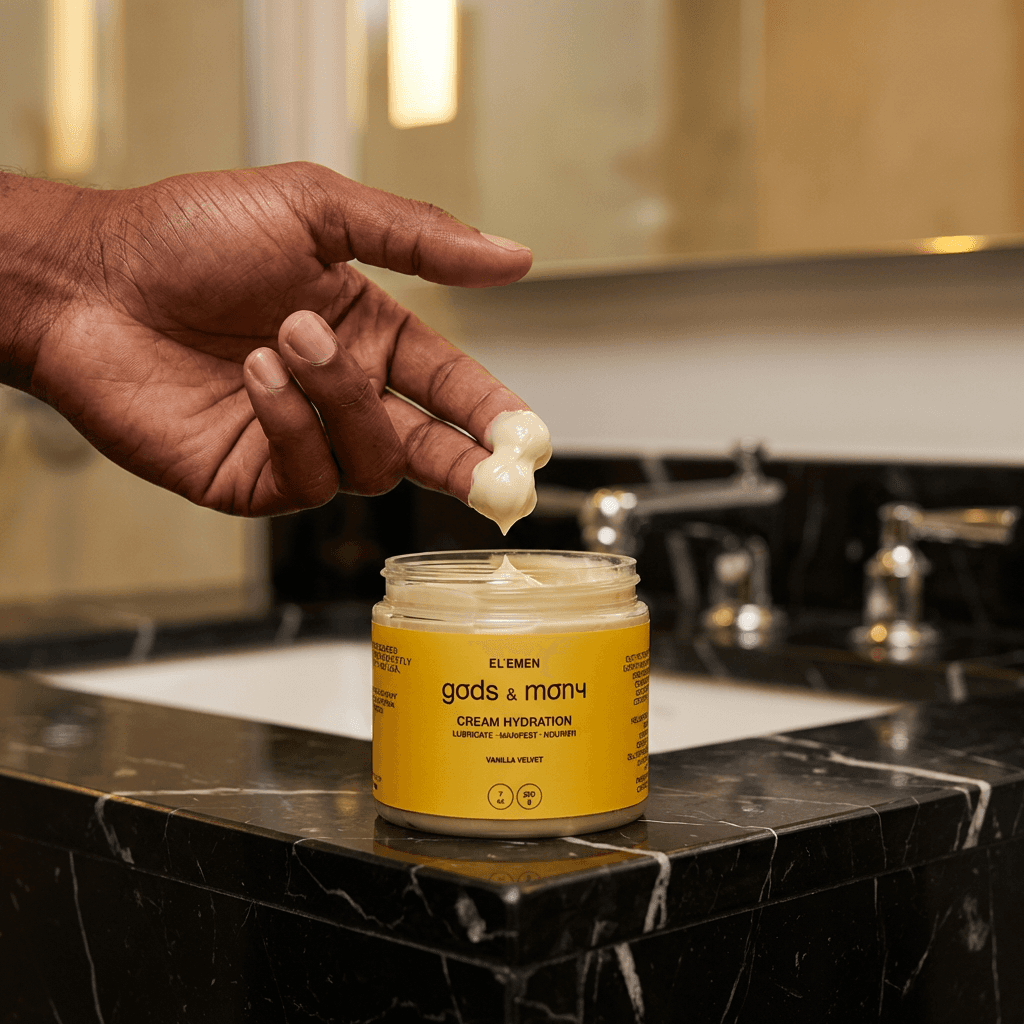
EL'EMEN Creme Hydration is the finish. It seals everything in. Skin that holds water reads younger, calmer, and more expensive than skin that doesn't. Add the EL'EMEN Moisturizing Oil on the days the air is dry or the schedule is brutal.
Three products. Five minutes. A face that does the work of a wardrobe.
The Wardrobe: Five Anchors, Not Fifty Pieces
Old money owns less.
That's the secret. The closet is smaller. The pieces are heavier. The rotation is tighter. Nothing in the closet is a maybe.
You don't need fifty looks. You need five anchors that quietly multiply.
Anchor one: the white crewneck tee. Heavy cotton. Cut clean at the shoulder. Worn under everything or over nothing. The Resonant Standard Tee is built for this exact slot. Substantial weight, clean silhouette, no graphic noise.
Anchor two: the crewneck. Pulled on over the tee, under a blazer, on a Sunday, on a flight. The Atelier Crewneck reads as effort without trying. The grey version sits even quieter for the men who'd rather not be photographed.
Anchor three: the hoodie that doesn't shout. Old money does wear hoodies. They just choose ones that look like they cost money even when wet. The Atelier Hoodie is that hoodie. Cut, cotton, and weight that all read intentional.
Anchor four: dark denim or trouser. One indigo. One charcoal. Tailored at the leg. Nothing distressed. Nothing decorative. The pants disappear and the man stays.
Anchor five: the shoe that ages. Leather lace-ups, suede loafers, or clean white sneakers in heavy canvas. No logos. Polished or replaced. Never tired.
Five anchors. Built right, that's a year of mornings without thinking.
The Grooming Ritual Behind the Look
The wardrobe is what people see. The ritual is what makes the wardrobe land.
Old money men have routines. Not products on a shelf. Routines. The order matters more than the count.
Morning.
Wash the face. Cold water last. HOMME The Wash Up.
Treat the surface. Exfoliate twice a week with EXFOLIARE. The rest of the week, skip.
Hydrate. EL'EMEN Creme on damp skin. Oil if needed.
Dress in five anchors. Cut, weight, and fit do the talking.
Coffee. Not on the run. Standing still.
That's the ritual. It looks small because it is. Old money is built on small things repeated without negotiation.
Affluent millennial men report wanting to look their best but not feeling great about the effort it takes. That gap is the opportunity. Most men either do nothing or do everything. The man who does three things and does them every day pulls ahead without breaking a sweat.
Discipline beats intensity. Always has.
What Old Money Men Never Wear
The list of what to wear is shorter than the list of what to avoid.
Visible logos. A logo is a label you wear for the brand. Old money is the label.
Box-fresh sneakers stacked with hype tags. A clean shoe is fine. A status sneaker priced for resale is not. The first reads taste. The second reads anxiety.
Anything wrinkled, anything pilled, anything stretched at the collar. Maintenance is the cheapest form of status. If you can't iron, find someone who can.
Cologne that announces you in the hallway. Old money is a clean scent at handshake distance. Anyone smelling you from across a room is paying too much attention to the wrong thing.
Skincare in the bathroom that you never use. The dust on a bottle is a confession. Either build the ritual or don't buy the products. Pretending wears worse than nothing.
Trends with an expiration date. If a piece will read dated in 18 months, it doesn't belong in the closet. Old money plays the long game. Always has.
The LA Version of Old Money
There is an East Coast old money. Boarding schools. Heritage tweeds. A specific silence in the room.
Then there is the LA version. Different city. Same code.
LA old money doesn't wear the tweed. It wears the white tee, the lived-in crew, the leather jacket on a Wednesday. The clothes are simpler. The skill is keeping them clean while the weather, the hours, and the city try to wear them down.
This is the Gods and Mony brief from the beginning. Resonant grooming for men who command presence. Clean, organic, USA-made. The aesthetic of money that does not need to be loud about itself.
The Sip Mo statement tee and the Founder's Crewneck push the language further. Statement pieces for men who'd rather speak than be quoted. Both still built on the same code. Heavy cotton. Clean cut. No noise where noise isn't earned.
Old money in LA is sun, sweat, and standards. The standards are what survive the sun.
The LA version also rewrites one rule. You don't get to hide under a coat. There is no overcoat covering the wrinkled shirt. There is no scarf disguising the dull skin. The climate exposes everything.
So the discipline shifts. Skincare matters more here than it does in any other city in the country. Sunlight ages a man fast. Heat thins the patience for layers. The look has to work in a t-shirt or it doesn't work at all.
That is why the Gods and Mony skincare collection was built the way it was. Made for the man who can't hide. Built to hold up under sun, gym, late nights, early calls. The whole code rests on one idea. Earn the surface, then the wardrobe takes care of itself.
Buy Less. Buy Better. Wear Forever.
Here's the part most men skip.
Old money is not an aesthetic. It's an arithmetic.
You buy fewer pieces. You pay more for each one. You wear them for a decade instead of a season. The math works in your favor every year you keep the rule.
The same logic runs the grooming shelf. One serious wash, one serious exfoliant, one serious moisturizer. Used daily. For years. The cost per use crashes. The result compounds.
The men who look effortless aren't fighting harder than you. They're choosing less and protecting it more.
If you want a head start, the All of the Wash bundle and the Cream Rules Everything Around Me bundle are the two ritual anchors. Three products, daily use, no thinking. The exact arithmetic the look is built on.
Browse the full skincare collection and the apparel collection once. Then stop browsing.
The next move is the man.
He doesn't need permission. He doesn't need a label. He doesn't need to convince anyone of anything.
He just walks in.
The room knows.
Frequently Asked Questions
What is old money style for men?
Old money style is a way of dressing built on quiet confidence, quality fabrics, and timeless cuts instead of logos and trends. It signals wealth and taste through restraint rather than display. Think heavy cotton tees, clean tailoring, classic shoes, and a face that looks tended without trying. The look is downstream of a ritual. Build the ritual first.
How do I dress like old money on a budget?
Start with five anchors instead of fifty pieces. A white heavyweight tee, a clean crewneck, dark trousers, plain leather shoes, and a low-logo hoodie cover almost every situation. Spend more per item, buy less often, and protect what you own with steady maintenance. Then add a grooming routine that keeps the skin clear. A tended face raises every outfit one tier without raising your spend.
Is quiet luxury the same as old money style?
They overlap heavily. Quiet luxury describes the buying behavior, fewer items, higher quality, less branding. Old money describes the cultural posture behind it, restraint, lineage cues, and inherited confidence. In practice for most men, they translate to the same wardrobe and the same daily standards. The difference is mostly vocabulary.
What grooming products fit old money style?
Anything clean, organic, and effective is the right answer. The look is built on skin that reads calm and well-kept. HOMME The Wash Up, EXFOLIARE, and EL'EMEN Creme form the three step ritual most men in this category run. The point is consistency, not collection. Three products used every day beat ten products used sometimes.
Can young men pull off old money style?
Yes, and usually better than older men trying it for the first time. Younger men have the build, the schedule, and the discipline to commit to the look while they grow into the income. The earlier you build the ritual, the more natural the posture becomes by your thirties. Treat the years between now and then as the apprenticeship.
How is old money style different from minimalism?
Minimalism is about removal. Old money is about precision. A minimalist closet might be five plain items chosen for simplicity. An old money closet is five exceptional items chosen for cut, weight, and longevity. Same headcount. Different intent. Minimalism is the discipline of less. Old money is the discipline of better.
Take the Gods and Mony grooming quiz to find the products that match your skin and your schedule. Or browse the bundles and gift cards page for the curated starter sets.
Old money never explained itself. It just kept showing up. Better dressed. Cleaner skinned. Quieter. Until quiet was the loudest thing in the room.
That man is already inside you.
You just have to stop performing long enough to be him.
Gods and Mony Editorial
Editorial Team
Next posts