Better isn't a personality — it's a practice you return to, one day at a time.
How to Be a Better Man: The Daily Practice No One Told You About
18 min read
true

In This Article
Key Takeaways
Stop Treating "Better Man" Like a Checklist
The Data Most Men Would Rather Not Read
Why It's a Practice, Not a Personality
The Keystone Habits That Quietly Build a Better Man
Grooming: The Outward Proof of Inner Standards
The Better Man Is the One Others Can Rely On
How to Actually Start (Without Overhauling Your Life)
Frequently Asked Questions
The Practice Is the Point
Being a better man is not a destination you arrive at. It's a practice you return to, one ordinary day at a time.
That reframe matters, because most men are chasing the wrong thing. They treat "better man" as a finish line — a version of themselves that, once reached, stays reached. So they look for the big move. The dramatic reinvention. The single decision that will finally make them the man they picture in their head.
But character doesn't work like a lightning strike. It works like interest. It compounds quietly, from small deposits made on days when no one is watching and nothing feels like it's changing. The man you respect didn't become that man in a weekend. He became him in a thousand unremarkable mornings. Growth like this also changes how the world treats you, and it pairs naturally with learning the habits behind commanding real respect.
This is a guide to those mornings. Not a checklist of traits to collect. A practice to build — grounded in what the current research actually says about how men change, how we connect, and why the smallest disciplines end up carrying the most weight.
Key Takeaways
Better isn't a personality — it's a practice. Character is built through repeated small actions, not acquired in one dramatic decision. New habits take a median of 59 to 66 days to lock in, not the mythical 21 (University of South Australia, 2024).
The real gap for men isn't strength — it's connection. Men and women feel lonely at similar rates, but only 38% of men reach out to a friend for emotional support versus 54% of women (Pew Research Center, 2025). Learning to use your relationships is a skill, not softness.
Young men are quietly struggling. 25% of U.S. men aged 15–34 felt lonely "a lot" of the previous day — the loneliest demographic in the country (Gallup, 2025). Becoming a better man starts with facing that honestly.
Self-improvement isn't fringe — it's a $53 billion movement. The global personal development market reached roughly $53 billion in 2025 (Precedence Research, 2025). Working on yourself is now the norm, not the exception.
Grooming is the outward proof of inner standards. 60% of men buy grooming products specifically to maintain their look over time (NielsenIQ, 2025) — a small, daily keystone habit that trains the same discipline you'll draw on when the stakes are real.
Stop Treating "Better Man" Like a Checklist
Search this question and you'll drown in lists. Sixteen ways. Thirty-one habits. The same recycled buckets every time: hit the gym, read more, keep your word, dress sharper, be disciplined. None of it is wrong. All of it is incomplete.
Because a list treats character like inventory — a set of traits you acquire and then own. That's not how men actually change. You don't have discipline the way you have brown eyes. You do discipline, or you don't, in the specific moment it's asked of you. Every trait worth having is really a verb wearing the costume of a noun.
That distinction changes the whole project. If "better man" is a fixed identity, then every failure is evidence you're not that type. Miss a workout, lose your temper, break a promise to yourself — proof you don't have what it takes. But if it's a practice, a missed day is just a missed day. You don't quit the gym because you skipped one session. You go back.
The men who improve are not the ones with more willpower. They're the ones who stopped grading their whole identity on single days and started simply returning to the practice. Consistency over intensity. Direction over arrival.
So the honest answer to how to be a better man isn't a list of who to become. It's a smaller, harder question you answer every morning: what does the better version of me do next?
The Data Most Men Would Rather Not Read
Before we talk about building, we have to be honest about where a lot of men are starting from — because the modern male experience has a quiet crisis running underneath it.
Young men are the loneliest people in America. A 2025 Gallup analysis found that 25% of U.S. men aged 15 to 34 said they felt lonely "a lot of the previous day" — higher than the national average of 18% and higher than young women (Gallup, 2025). The same data found 57% of young men report feeling stressed daily. This isn't a fringe. It's a generation.
But here's the finding that reframes everything. According to Pew Research Center, men and women actually report feeling lonely at roughly the same rate. The gap isn't in how much men struggle — it's in what they do with it. When they need emotional support, only 38% of men reach out to a friend, compared to 54% of women. Only 16% turn to a mental health professional, versus 22% of women (Pew Research Center, 2025).
Read that again. Men aren't lonelier because they have fewer people. They're lonelier because they've been trained not to use the people they have.
The friendships themselves have thinned, too. The share of men with zero close friends rose from 3% in 1990 to roughly 15% today — a fivefold jump — while men reporting six or more close friends fell from 55% to 27% (Survey Center on American Life). And it shows up in whether men get help at all: in 2023, only 45.9% of men with a mental illness received treatment, roughly half the rate of women (CDC / NCHS, 2023).
None of this is here to depress you. It's here to relocate the target. For a long time, "be a better man" meant be harder — more stoic, more self-contained, more of a fortress. The data says the modern work is almost the opposite. The stronger move now is learning to reach, to connect, to let the right people in. That's not weakness leaking into masculinity. That's masculinity growing up.
Why It's a Practice, Not a Personality
Here's the science that should change how you hold every hard day.
You've heard it takes 21 days to build a habit. It's one of the most repeated claims in self-improvement, and it's wrong. A 2024 systematic review out of the University of South Australia — pooling 20 studies and more than 2,600 participants — found the median time to form a new habit was 59 to 66 days, with a range stretching from 4 days to 335 depending on the person and the behavior (University of South Australia, 2024).
Sit with that number. The change you're trying to make will not feel automatic for roughly two months. That's not you failing. That's the actual physics of becoming.
Most men quit around day 12. They conclude they "don't have the discipline," pocket the evidence as proof they were never the type, and go back to who they were. They weren't lacking anything. They were early. They mistook the dip for the destination.
This is why the practice framing beats the personality framing so completely. When you believe better is a trait, the hard middle stretch reads as a verdict — see, I'm not that guy. When you know it's a practice on a 60-day clock, the same discomfort reads as the process running exactly on schedule. You stop negotiating with the friction and start counting the reps.
And you're not alone in the project. The global personal development market reached roughly $53 billion in 2025 and is projected to nearly double by the mid-2030s (Precedence Research, 2025). Working on yourself stopped being self-indulgent somewhere in the last decade. It's now one of the most common things ambitious people do. The question was never whether to build. It's what to build first.
The Keystone Habits That Quietly Build a Better Man
Not all habits are equal. A few of them — the ones behavioral researchers call keystone habits — do disproportionate work, because getting them right makes every other good behavior easier. These are the deposits worth making first.
1. Keep the promises you make to yourself
Self-respect isn't a feeling you find. It's a reputation you build with yourself, one kept word at a time.
Every time you say you'll do something and then do it — the workout, the early alarm, the hard conversation — you cast a vote that your word means something. Every time you don't, you teach yourself that your commitments are negotiable. Do that enough and you become a stranger you can't quite trust.
Start absurdly small. One promise a day you are certain you can keep. Make the bed. Drink the water. Do the ten push-ups. The point isn't the task — it's the evidence. You are building the identity of a man who does what he said he would, and that identity becomes the engine under everything harder.
2. Learn to actually use your relationships
Given the data above, this may be the single highest-leverage habit for a modern man. You likely don't need more friends. You need to stop treating the ones you have as furniture. If yours have already gone quiet, our guide to rebuilding male friendships sets out the structure that brings them back.
Emotional intelligence — the skill of naming what you feel and letting the right people in on it — is not softness. It's range. And it compounds: competencies measured at graduation have been shown to predict career satisfaction and success many years later (Frontiers in Psychology / PMC). The man who can hold a real conversation, apologize cleanly, and ask for help without flinching has an advantage the fortress will never have.
The practice is small and terrifying: one honest message a week. Text the friend you've been meaning to. Say the true thing instead of the easy one. Answer "how are you" with something real. You're not becoming less of a man. You're becoming a more complete one — the stoic man who is composed and connected, not composed because he's cut off.

3. Treat people better than the moment requires
Character is what you do when there's nothing in it for you. The waiter. The stranger. The person who can't help your career. How you treat people who can do nothing for you is the truest measurement there is, because it's the one no audience is scoring.
This is also where a lot of men perform "better" and never become it. Being kind to those above you is strategy. Being kind to everyone is character. Aim for the second and the first takes care of itself.
4. Build the body to steady the mind
You don't train to look like something. You train to become someone who keeps showing up. The gym is rarely about the gym — it's a controlled environment where you practice doing a hard thing you don't feel like doing, which is exactly the muscle real life demands. If you want the fuller argument, we made it in how to build discipline. The short version: movement is the cheapest available tool for a steadier temperament, and a body you've invested in changes how you carry yourself into every room.
5. Groom like a man with standards
This is the keystone habit most men underrate, and it's the one that folds neatly into a better day — which is exactly why we'll give it its own section next.
Grooming: The Outward Proof of Inner Standards
Here is a truth the checklist articles reduce to "dress better" and then skip past: how you tend to yourself is the most visible evidence of how you regard yourself.
It's not vanity. The market already knows this. The U.S. men's grooming category hit $7.1 billion in sales in 2025, up 6.9% year over year, and — this is the telling part — 60% of men now buy grooming products specifically to maintain their look over time, with 40% saying premium brands are worth the price (NielsenIQ, 2025). Men aren't grooming to impress a room. They're grooming to maintain a standard.
That word — maintain — is the whole point. A grooming ritual is a keystone habit hiding in plain sight. It's a small, daily, non-negotiable act of care that you perform whether or not you feel like it, whether or not anyone will see the result. Which is to say: it's discipline you can practice in ninety seconds before the day even begins. Master the bar you can reach every morning and you strengthen the muscle you'll need for the bars you can't.
There's a reason the composed man tends to be a well-kept one. The daily ritual sets a floor. Before you've answered a single email, you've already kept a promise to yourself, already told your own nervous system that you're a man worth the effort. That's not a small thing. That's the first vote of the day, cast for the man you're becoming.
Build the ritual so it's frictionless enough to actually keep:
Start clean. HOMME The Wash Up is the foundation — an organic, USA-made body and skin wash that turns the most automatic part of your morning into the first deliberate act of the day. The keystone works because it's already a habit; you're just raising the standard of it.
Clear the slate. Two or three mornings a week, EXFOLIARE Exfoliant resets the skin so everything after it lands better. Consistency, not intensity — the same principle that governs every habit on this list.
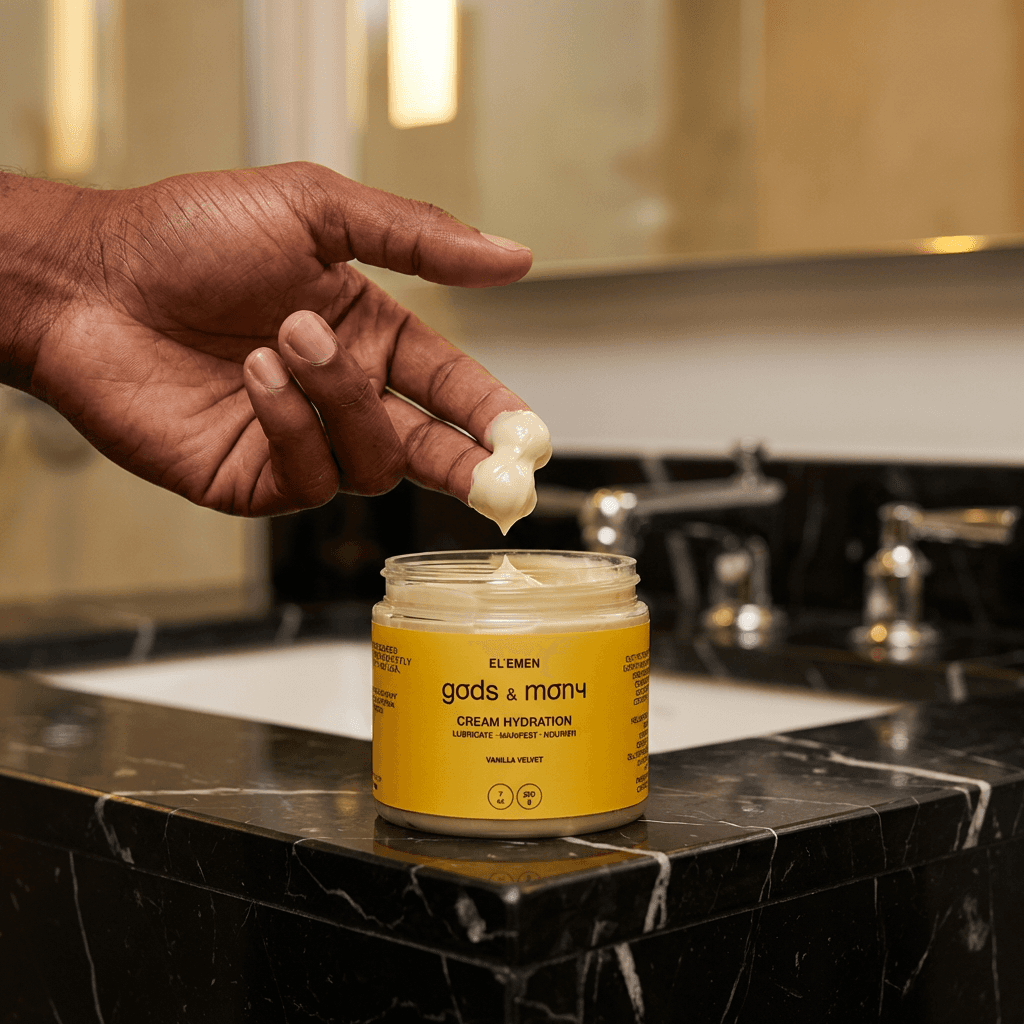
Protect what you've built. EL'EMEN Creme Hydration is the maintenance step the 60% understand instinctively. Skin you tend to daily is skin that reflects a man who plans past today.
Finish with intention. A few drops of EL'EMEN Moisturizing Oil is the small luxury that signals the ritual is complete — the punctuation mark on a morning you ran on purpose.
If you're not sure where to begin, the skincare collection is built to be simple, and the two-minute quiz will point you to the exact routine for your skin. The goal isn't a shelf of product. It's a floor you never drop below.
The Better Man Is the One Others Can Rely On
Strip away the abstractions and being a better man comes down to a single question the people around you are always quietly answering: can I count on him?
Not "is he impressive." Not "is he successful." Can he be relied on — to keep his word, to stay level when it's hard, to show up when it's inconvenient, to be the same man in private that he is in public. Reliability is the least glamorous virtue and the most valuable one, because everything good in a life is built on top of it. Trust, love, respect, leadership — all of it sits on the foundation of a man who does what he says.
This is also where the people who love you enter the story. The partners, the parents, the friends who nudge a man toward taking better care of himself are rarely being superficial. They're recognizing something true: a man who tends to himself tends to have more to give. Self-care isn't the opposite of showing up for others — it's often the prerequisite. You can't pour from a man running on empty. Tending to your own standards, your own health, your own rituals is how you stay someone worth relying on.
That's the quiet promise inside the practice. You're not doing this to become admirable in the abstract. You're doing it to become dependable in the specific — for the people whose lives are, in ways they'll never fully say, held up by yours.
How to Actually Start (Without Overhauling Your Life)
Ambition kills more self-improvement than laziness ever will. The man who tries to change ten things on Monday has usually quit nine of them by Friday. So don't overhaul. Anchor.
Pick one keystone habit from the list above — the one that makes you slightly uncomfortable, because that's usually the one you need. Attach it to something you already do without thinking. After you brush your teeth, you groom. After your morning coffee, you send the honest message. After you park the car, you keep the promise. You're not adding a new slot to your day; you're bolting a good behavior onto an existing one.
Then hold the 60-day clock in your head. When day 12 arrives and the shine wears off and your brain offers you the old story — this isn't working, you're not that guy — you'll recognize it as the dip, not the verdict. You'll do the rep anyway. That single act, repeated, is the entire mechanism. There is no secret underneath it.
Give it two months and something strange happens. The thing you had to force starts to run on its own. And a man who has done that once knows, in his body, that he can do it again — with the next habit, and the next. That is the real prize. Not a finished self. A proven method for building one.
If you want more of that mindset, we've mapped adjacent ground in how to be mentally strong and mens confidence tips. You can also read the story behind the brand on our about page — we built Gods and Mony for exactly this kind of man.
Frequently Asked Questions
What are the most important traits of a good man? The traits people name — integrity, discipline, kindness, reliability — are really verbs, not fixed qualities. The most important one is reliability: being a man whose word can be counted on, in public and in private. Every other trait tends to grow out of the simple, repeated practice of doing what you said you'd do. Focus on consistency over any single dramatic virtue.
How long does it actually take to become a better man? There's no finish line, but the science offers a useful marker: new habits take a median of 59 to 66 days to become automatic (University of South Australia, 2024). Expect roughly two months of deliberate effort before a new behavior stops feeling like effort. The men who quit almost always quit inside the first two weeks, mistaking the hard middle for proof they can't change.
Is wanting to improve myself a sign of weakness? The opposite. Self-improvement is now a mainstream $53 billion global movement (Precedence Research, 2025), and the data shows the men who struggle most are often the ones who never reach for help or growth. Deciding to work on yourself is a sign of self-respect, not insecurity. Strength is knowing you're unfinished and choosing to build anyway.
How does grooming make me a better man — isn't that superficial? Grooming works as a keystone habit, not a vanity project. It's a small daily discipline that sets a standard before the day begins — and 60% of men now groom specifically to maintain their appearance over time, not to impress (NielsenIQ, 2025). Tending to yourself trains the same consistency you rely on everywhere else, and signals to yourself that you're a man worth the effort.
Where should I start if I want to change but feel overwhelmed? Pick one keystone habit and anchor it to something you already do. Don't try to fix everything at once — the man who changes ten things usually keeps none. Attach one new behavior to an existing routine (groom right after you brush your teeth, send one honest text after your morning coffee), and hold the 60-day timeline so you don't quit during the dip. One kept promise a day is enough to begin.
The Practice Is the Point
You will not wake up one morning as a finished man. That version of the goal was always a trap — a horizon that moves as fast as you walk toward it.
But you can wake up tomorrow and cast one vote. Keep one promise. Send one honest message. Run one deliberate morning instead of a default one. None of it will feel like transformation while it's happening. That's the nature of compounding — it's invisible right up until it's undeniable.
Being a better man was never about the man you'll become. It's about the man you're willing to practice being, today, before anyone is watching and while nothing seems to be changing.
Return to the practice. That's the whole secret. That's the entire art.
Start with the morning you can control. Build your ritual, take the two-minute quiz, and cast the first vote for the man you're becoming.

Gods and Mony Editorial
Editorial Team
Next posts