A gentleman isn't a costume you put on. It's a standard you refuse to lower.
How To Be A Gentleman: The Modern Man's Guide To Earned Presence
17 min read
June 24, 2026

How To Be A Gentleman: The Modern Man's Guide To Earned Presence
Most men think being a gentleman is a performance. Hold the door, fix the handshake, learn which fork goes where. Memorize the choreography and you pass.
They've got it backwards. Every man who's ever made you feel small while holding the door perfectly proves the point. Manners without character is just a costume — and everyone can tell. The real gentleman isn't running a script. He's expressing something that's already true about him: that he respects himself enough to respect you, that he has nothing to prove and so has nothing to defend, that his power is something he chooses to hold gently rather than wield. This is also why how you present yourself matters so much, because the world forms its first read of a man in seconds, well before his manners have a chance to speak.
That's the part the internet's "how to be a gentleman" lists never reach. They give you the surface and skip the source. So they hand you fifty rules to remember, when the truth is a gentleman doesn't remember anything — he just is, and the conduct follows automatically the way water follows the shape of the glass. This is a guide to building the man underneath, so the manners stop being effort and start being overflow.
Key Takeaways
Character comes first; manners are the overflow. The classic definition isn't about etiquette at all. John Henry Newman called a gentleman "one who never inflicts pain" — whose entire concern is putting others at ease (Cardinal Newman Society). Conduct is downstream of who you are.
The world is starving for it. Workplace rudeness now costs U.S. organizations over $2.7 billion a day in lost productivity, with an estimated 81 million acts of incivility daily (SHRM Civility Index, 2024). The bar is on the floor. Stepping over it is easier than ever.
You're judged before you speak. Princeton research found people form snap judgments of competence and trustworthiness from a face in as little as 100 milliseconds — and more time only makes them more certain, not more accurate (Princeton / Psychological Science). How you present is your opening argument.
Substance beats signaling with the people who matter. Young men think women rank attractiveness (50%) and status (39%) highest in a partner; young women actually name sense of humour (60%) and kindness (53%) (Ipsos, 2025). The gentleman wins on the qualities men keep underrating.
Grooming is self-respect made visible. The U.S. men's grooming category hit $7.1 billion, up 6.9%, with 60% of men now grooming to maintain their appearance over time (NielsenIQ, 2025). Caring for how you show up isn't vanity. It's the outward discipline of inner standards.
A Gentleman Is Built On Character, Not Choreography
Start here, because everything else is a branch off this root.
There's a comfortable lie built into most advice on this subject — that becoming a gentleman is a matter of acquiring behaviors. Learn the rules, run the rules, and the title is yours. It's comfortable because it asks nothing of who you actually are. You can be a small, resentful, status-hungry man and still hold a door. The behavior is hollow, but it's doable, and that's why the listicles sell it.
The men who wrote the original definitions weren't talking about behavior at all. They were talking about a quality of soul that produces behavior as a side effect. Newman, writing in 1854, said it is "almost a definition of a gentleman to say that he is one who never inflicts pain" — a man whose "great concern" is simply "to make every one at their ease and at home" (Cardinal Newman Society). Notice there's no rule in there. No fork, no handshake, no door. Just an orientation — toward the comfort of others rather than the inflation of self — that generates a thousand small acts of consideration without needing a single one of them memorized.
That's the reframe. You don't learn to be a gentleman the way you learn a dance. You become a certain kind of man, and the conduct takes care of itself. A man secure in himself doesn't interrupt, because he isn't anxious to be heard. A man who respects himself doesn't belittle the waiter, because cruelty to people who can't fight back is beneath the standard he holds. The manners aren't the cause of the character. They're the evidence of it. This is the same identity-first logic that runs underneath everything we write — you build the man, and the traits arrive as the natural verdict, exactly the way we lay it out in how to be a high value man.
The Forbearing Use Of Power
Here is the test that separates the real article from the imitation: what a man does with power over someone who can't push back.
A 19th-century definition, often quoted, gets at this better than anything written since: the true measure of a gentleman is "the forbearing use of power" — the restraint a strong man shows toward the weak, the inoffensive use of an authority he could easily abuse. Anyone can be civil to the people they need something from. The boss, the client, the woman he's trying to impress. That's not character; that's strategy. The gentleman is revealed in how he treats the people who have nothing to offer him and no way to retaliate — the junior employee, the tired barista, the stranger who made an honest mistake.
This is why a gentleman is, at his core, a man in command of himself before he commands anything else. The impulse to dominate when you can, to win the small exchange, to put someone in their place because you're able to — every man feels it. The gentleman simply doesn't obey it. He has the power and declines to use it as a weapon, and that restraint reads, to everyone in the room, as strength. Because it is. Reactivity is weakness wearing a loud costume. The man who can absorb a slight without firing back, who can hold authority without leaning on it, is operating from a depth the hotheads can't fake.
That self-mastery is trainable, and it's the oldest discipline there is. The Stoics built an entire philosophy on the gap between stimulus and response — the space where a man decides who he's going to be instead of letting the moment decide for him. We unpack that whole operating system in the stoic man, and it's the bedrock the rest of this rests on. You cannot be gentle with your power until you can govern yourself.
Manners Are Not Decoration — They're How You Make Someone Feel
Now we can talk about manners, because now they mean something.
The point of etiquette was never the rules. It was the result the rules were designed to produce: other people, in your presence, feeling respected, at ease, and seen. The fork and the door and the "please" are just delivery mechanisms for a single message — you matter, and I'm paying attention. When a man understands that, he stops needing to memorize the etiquette, because he can generate the right move in any situation by asking the only question that matters: what would put this person at ease?
And the market for that is wide open, because the baseline has collapsed. Workplace incivility — the rudeness, the curtness, the casual disregard — now costs American organizations an estimated $2.7 billion every single day in lost productivity and absenteeism, across some 81 million acts of incivility daily (SHRM Civility Index, 2024). Sit with that number. It's a measure of how rare basic consideration has become. Which means the man who actually possesses it doesn't blend in — he stands out, in rooms full of people who've forgotten how to make anyone feel valued.
This is the unglamorous superpower. Remember names and use them. Put the phone away and face the person talking to you. Let someone finish their sentence. Say thank you to the people the rest of the world looks through. Introduce the person standing awkwardly at the edge of the group. None of it is complicated. All of it is rare. And every act lands harder than it used to, precisely because so few men bother. The substance behind this — the magnetic ease that makes people want to be around you — is the same thing we break down in how to be charismatic. Charisma isn't performance. It's consideration, made consistent.

You Are Judged Before You Open Your Mouth
A gentleman knows something most men resist: presentation is not vanity, it's information, and people read it instantly whether you like it or not.
The research is almost unfair in how fast it happens. Princeton researchers found that people form judgments about a stranger's trustworthiness, competence, and likeability in as little as 100 milliseconds — a tenth of a second — and giving them more time to look didn't change the verdict, it only made them more confident in it (Princeton / Psychological Science). You don't get to skip this exam. You sit it every time you walk into a room. The only choice is whether you've prepared.
Preparing isn't about expensive clothes or a chiselled jaw. It's about looking like a man who handles himself — clean, deliberate, cared-for. That signal isn't shallow; it's honest. The man who takes ten minutes to show up well is telling the truth about his standards, the same way the man who shows up rumpled and depleted is telling the truth about his. And there's nothing performative about it, because the data shows men have quietly made this normal: the U.S. men's grooming category reached $7.1 billion, up 6.9% year over year, and 60% of men now groom specifically to maintain their appearance over time (NielsenIQ, 2025). This isn't a fringe pursuit anymore. It's table stakes.
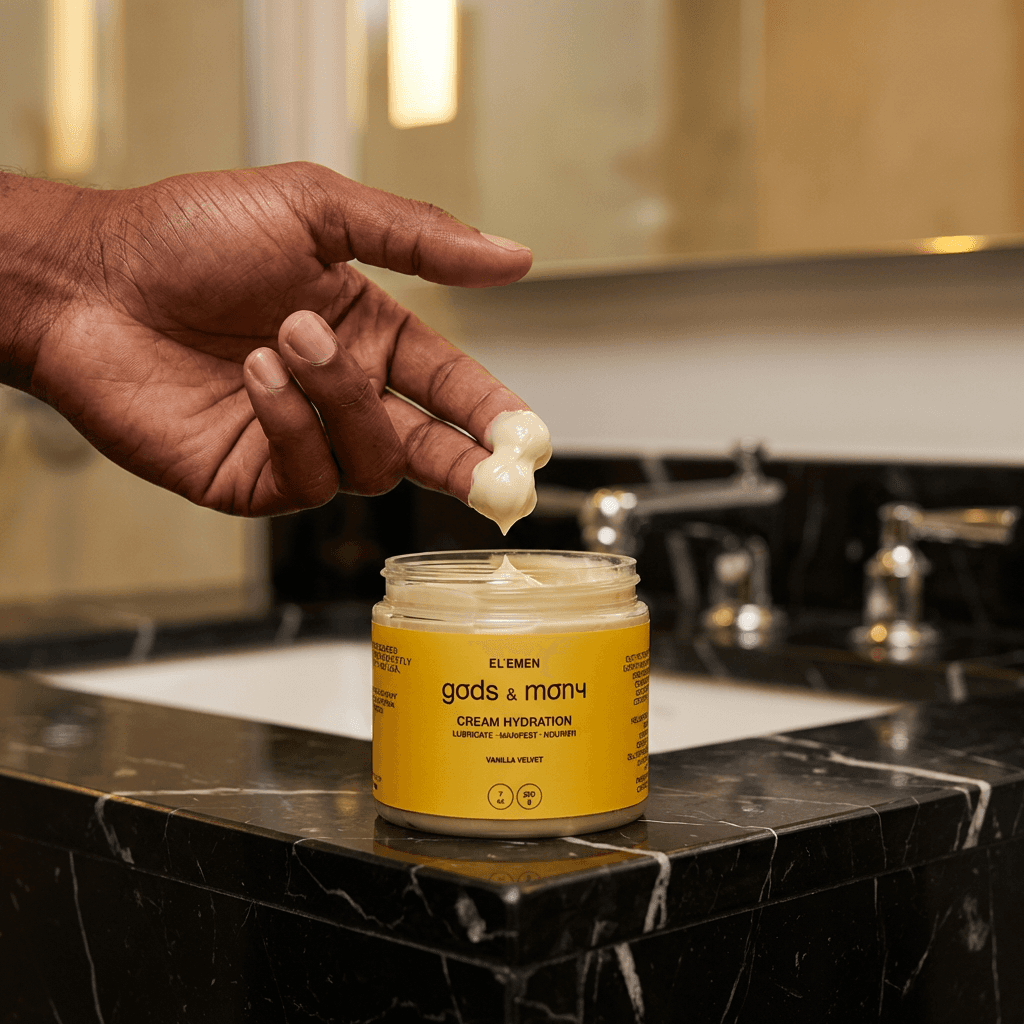
The good news is the foundation is genuinely simple, and you control it completely. Start with a wash that respects your skin instead of stripping it raw — HOMME The Wash Up is the daily reset, the two minutes that take the day off your face. A couple of times a week, clear away the dead skin and grit so you don't read as dulled-out and tired — that's the job of EXFOLIARE. Then put moisture back, because dry, flaky skin makes a man look worn no matter how sharp he feels: EL'EMEN Creme Hydration handles that in seconds, and for the man who wants the finished, deliberate look, a few drops of EL'EMEN Moisturizing Oil leaves skin looking healthy rather than greasy.
That's the whole foundation. Three or four steps, ten minutes a day. The men who've figured this out treat it as infrastructure, not indulgence — the same way they treat the gym and the early alarm — and we mapped exactly how they run it in grooming habits of successful men. If you're not sure where your own skin should start, the skincare quiz sorts it in about a minute. Presence isn't built on a great face. It's built on a man who clearly respects the one he has.
Emotional Maturity Is The Gentleman's Real Edge
Strip away the style and the manners and you find the engine underneath: a gentleman is emotionally grown.
This is the quality that can't be bought or borrowed, and it's the one the modern world rewards most. He doesn't make his mood everyone else's problem. He doesn't need to be the loudest, the funniest, or the most right in every exchange. He can take feedback without collapsing and give it without wounding. He can sit in a tense moment without rushing to fill it or defuse it with a joke. That steadiness — the sense that a man is governed from the inside rather than blown around by whatever he's feeling — is what makes people trust him, defer to him, and want him in the room when things get hard.
And it's not soft. It's the hardest currency there is. The research lineage that Daniel Goleman popularized in Emotional Intelligence keeps proving out: the ability to read a room, regulate yourself, and respond rather than react predicts success in work and relationships more reliably than raw intellect does. Employers have caught on — soft skills and emotional intelligence now top the list of what they say predicts long-term success, ranked above technical ability in survey after survey through 2025. The man who can manage himself is, increasingly, the man who gets handed the responsibility.
The mistake is thinking this is a personality you're born with. It isn't. Emotional maturity is built the same way physical strength is — through reps under load. Every time you feel the heat rise and choose the measured response instead of the reactive one, you've done a rep. Every time you stay calm while someone else loses it, you've added weight to the bar. Cold exposure, hard training, the conversation you'd rather avoid — these aren't separate from becoming a gentleman, they're the gym where the gentleman's composure gets built. The full machinery of holding steady when everything in you wants to react is the same one we cover in men's confidence tips: confidence and composure are both verdicts your own mind returns after watching you keep your head.
The Gentleman In The Real World
Here's where it pays off — and where most men are quietly getting the equation wrong.
Ask young men what women want in a partner and they'll tell you it's looks and money: in a 2025 Ipsos survey, men guessed women prioritize attractiveness (50%) and financial status (39%). Ask the women, and the real answer is almost the opposite — they named sense of humour (60%) and kindness (53%) as what they value most (Ipsos, 2025). That gap is the whole story. A generation of men is grinding to signal status and dominance, chasing the metrics they assume matter, while the people they're trying to reach are quietly weighting warmth, wit, and decency — the exact qualities a gentleman is built on.
This is why the gentleman wins where the performer fails. The performer leads with the signal: the watch, the flex, the curated highlight reel, the dominance display. It works for about a tenth of a second — right up until the substance is supposed to show up and there's nothing there. The gentleman leads with the substance: he's genuinely interested in the person across from him, genuinely steady, genuinely kind without being weak. He doesn't perform value. He has it. And it reads, over any timeline longer than a first glance, as the more attractive thing — because it is.
It also ages well, which the performance never does. Status signals decay; you can always be out-flexed by a richer, younger, louder man. Character compounds. The man known for his word, his steadiness, and the way he makes people feel only becomes more valuable as the years stack up, because those qualities are scarce and they don't fade. There's a reason genuine class always reads as quiet — it has nothing to prove. We go deep on that aesthetic of understatement in old money style for men, but the principle reaches far past clothes: the loudest man in the room is almost never the most secure one.
Build The Man, And The Reputation Follows
So here's the truth underneath every rule you've ever read about being a gentleman.
You cannot get there by collecting behaviors. You get there by becoming a man whose behavior has no choice but to be considerate, restrained, and self-respecting — because that's simply who he is now. Stop trying to act like a gentleman. Start building the man a gentleman's conduct belongs to. Govern your reactions until restraint is automatic. Care for how you show up until it's a habit, not a debate. Treat the people who can't help you exactly as well as the people who can. Lead with substance and let the signals take care of themselves.
Do that, and you'll notice something: you stop thinking about the rules entirely. You don't remember to hold the door — you just do, because making the moment easier for someone else is now reflex. You don't perform calm under pressure — you're calm, because you've trained the muscle a thousand times in private. The manners that other men strain to remember become, for you, the natural runoff of a settled, self-respecting man. That's the destination. Not a better performance. No performance at all.
Being a gentleman was never about impressing anyone. It's about holding a standard so consistently that it stops being something you do and becomes something you are. Start with one thing today — the reaction you don't fire back, the name you remember, the ten minutes you spend showing up like a man who respects himself — and let the evidence build. The reputation is just what other people call the man you quietly became.
Frequently Asked Questions
What actually makes a man a gentleman?
Character, not choreography. The classic definition — Newman's "one who never inflicts pain," whose concern is putting others at ease — has no rules in it at all. A gentleman is a man secure enough in himself that consideration, restraint, and respect come naturally, without needing to be performed. The manners everyone associates with the word are real, but they're the result of that character, not the cause. Build the man, and the conduct follows on its own.
How can I become a gentleman if I wasn't raised to be one?
The same way you build anything that lasts — through reps, not background. None of it is genetic or class-bound. Start with self-governance: the reaction you choose not to fire back, the impulse to dominate that you decline. Add consideration: remember names, put the phone away, treat the people who can't help you well. Add presentation: a simple grooming routine that says you respect yourself. Do these consistently and they stop being effort and become identity. Your upbringing decides where you start, never where you finish.
Is being a gentleman outdated or weak?
The opposite. Restraint, composure, and consideration read as strength precisely because they're rare — workplace rudeness alone costs U.S. organizations over $2.7 billion a day, which tells you how low the baseline has fallen. A man who can hold power without abusing it and stay calm while others react isn't soft; he's operating from a depth most can't fake. In a world this coarse, genuine class stands out more than ever.
Does how I look really matter, or is that shallow?
It matters, and it isn't shallow — it's information. People form judgments about your competence and trustworthiness in about 100 milliseconds of seeing you, and you don't get to opt out of that exam. Looking cared-for isn't vanity; it's the honest outward signal of inner standards. A simple routine — wash, exfoliate, moisturize — is enough. You don't need a perfect face, just to look like a man who respects the one he has.
What's the single most important gentlemanly trait?
The forbearing use of power — how you treat people who can't do anything for you and can't fight back. Anyone is civil to the people they need. The gentleman is revealed in how he treats the waiter, the junior, the stranger who made a mistake. That restraint, the choice not to use an advantage as a weapon, is the root the whole thing grows from. Master that and the rest of the conduct follows naturally.
Being a gentleman starts with respecting yourself enough to show up handled — and that begins with the basics. Explore the full Gods and Mony skincare collection, find your routine with the skincare quiz, or learn what we stand for on our about page.

Gods and Mony Editorial
Editorial Team
Next posts